
In this article
Are you looking to maximise your annual leave for 2026?
Get this year's guide here.
Quick Takeaways
- Get longer breaks by tagging your annual leave onto bank holiday weekends, Christmas and Easter
- Book all your leave around strategic dates and enjoy over 60 consecutive days off
- Lock in your dates for 2027 and avoid clashes by booking early
In this article we’ll give you the secret formula to double your 2027 annual leave by planning in advance and piggy-backing on bank holidays. Settle in for your favourite admin job of the year – leave stacking, the ultimate holiday hack.
What is leave stacking? (and why it works)
Leave stacking is a clever way to make your statutory entitlement stretch further by booking leave around weekends and national public holidays, giving you the maximum number of consecutive days off without maxing out your allowance.
How annual leave and bank holidays interact
In the UK and Ireland, we are treated to several bank holidays throughout the calendar year, where (pretty much) everyone gets a day off work. The secret to leave stacking is to request days off immediately before and/or after these public holidays, with “free days” as the bridge between annual leave days.
This is how you turn four days of annual leave into a nine-day stretch of freedom. Effectively, you are using the government’s scheduled breaks to subsidise your own leisure time.

Weekends, bank holidays and “free days”
This is where the magic happens. As well as “anchor points” to book your leave around, public holidays (usually) don’t count toward your statutory 28-day annual leave allowance (or your employer’s specific equivalent). And of course, neither do weekends. These “free days” helpfully pad out your time off at no cost to your leave balance.
For example, if you take Tuesday to Friday off after a bank holiday Monday, you don’t just get the four days you’ve booked, you get nine: two full weekends plus the leave, plus the bank holiday. These freebies are the key to turning 25 days of leave into 60+ days of fun and frolics (or just snoozing – you do you!).
The power of strategic planning (not luck)
If you want to secure a leave stacking win for 2027, there’s no room for chance and no time to waste. It’s a game of speed and precision. Because bank holidays are fixed and often coincide with school holidays, you might have stiff competition. That’s why you need to go in early, elbows sharpened (metaphorically, of course) and armed with a solid plan, ready to submit your requests the moment the 2027 holiday calendar opens.
You might not have previously been that fussed about the Easter holidays, but a 16-day break for the price of 8 annual leave days? It’s enough to make anyone put on bunny ears and start chirping.
UK & Ireland Bank Holidays in 2027
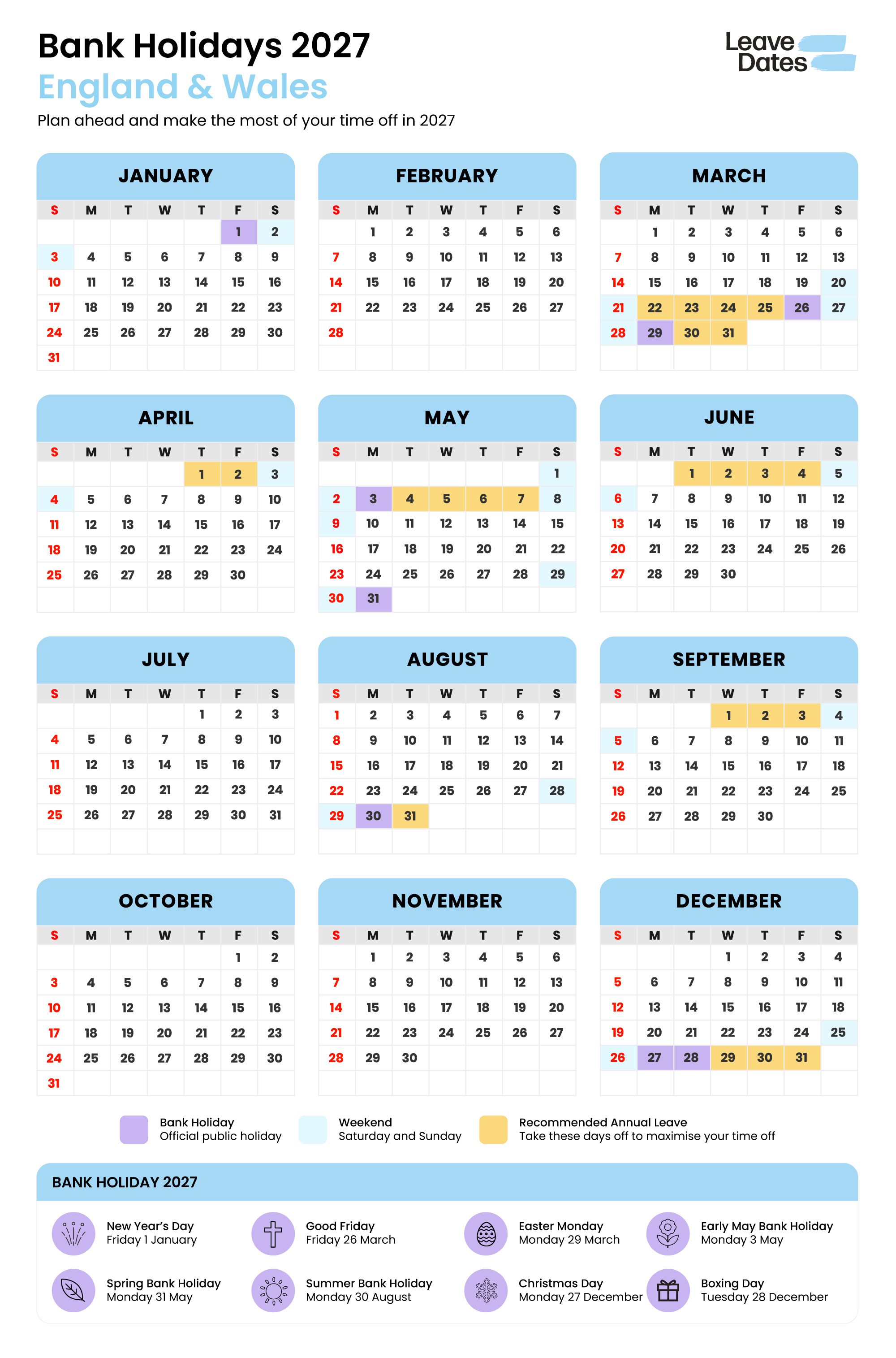
England and Wales have eight bank holidays in 2027:
- New Year’s Day – Friday, 1 January 2027
- Good Friday – Friday, 26 March 2027
- Easter Monday – Monday, 29 March 2027
- Early May Bank Holiday – Monday, 3 May 2027
- Spring Bank Holiday – Monday, 31 May 2027
- Summer Bank Holiday – Monday, 30 August 2027
- Christmas Day – Saturday, 25 December 2027 (substitute day Monday, 27 December)
- Boxing Day – Sunday, 26 December 2027 (substitute day Tuesday, 28 December)
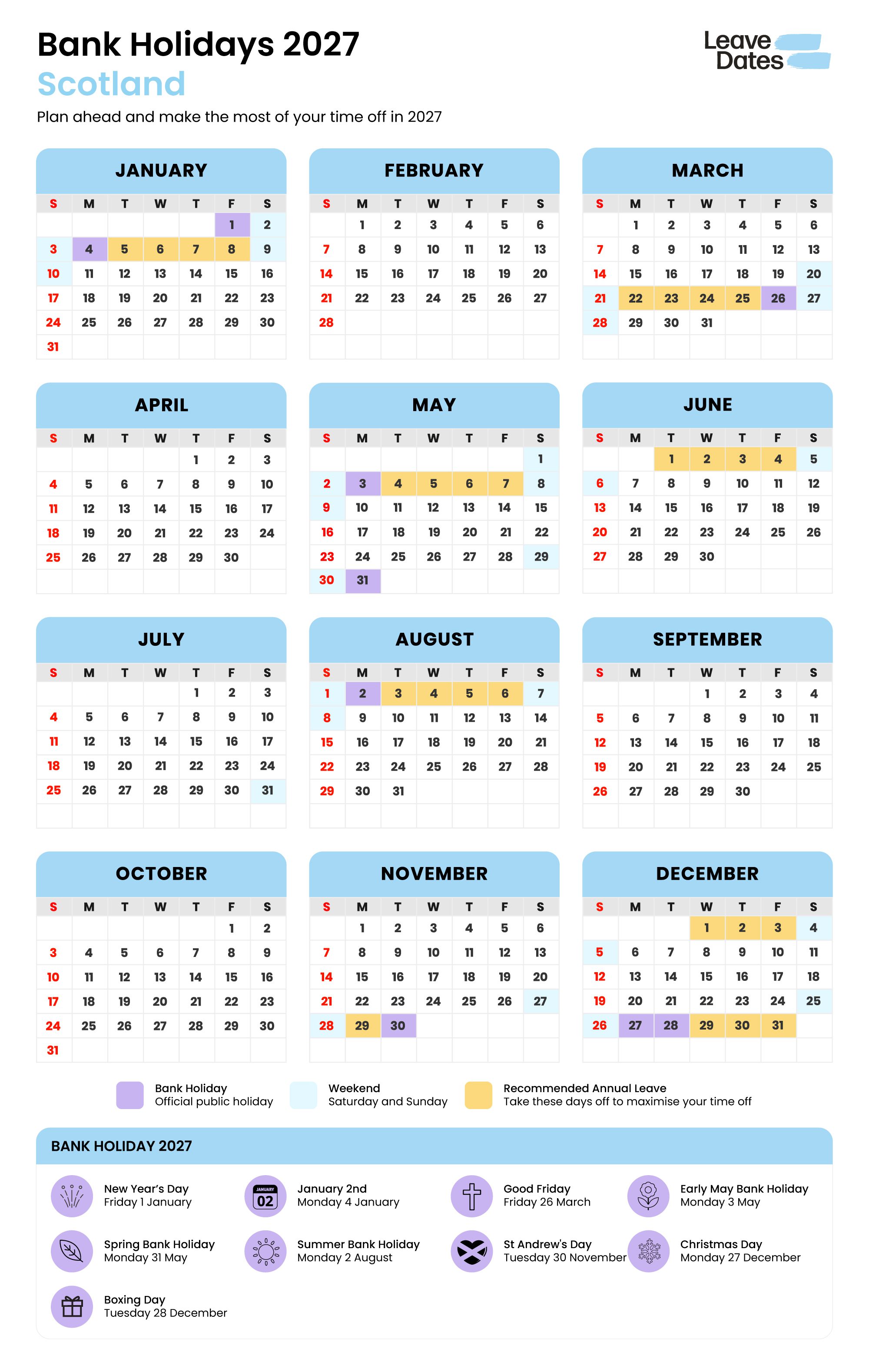
Scotland has nine bank holidays in 2027:
- New Year’s Day – Friday, 1 January 2027
- 2nd January (substitute day) – Monday, 4 January 2027
- Good Friday – Friday, 26 March 2027
- Early May Bank Holiday – Monday, 3 May 2027
- Spring Bank Holiday – Monday, 31 May 2027
- Summer Bank Holiday – Monday, 2 August 2027
- St Andrew’s Day – Tuesday, 30 November 2027
- Christmas Day (substitute day) – Monday, 27 December 2027
- Boxing Day (substitute day) – Tuesday, 28 December 2027
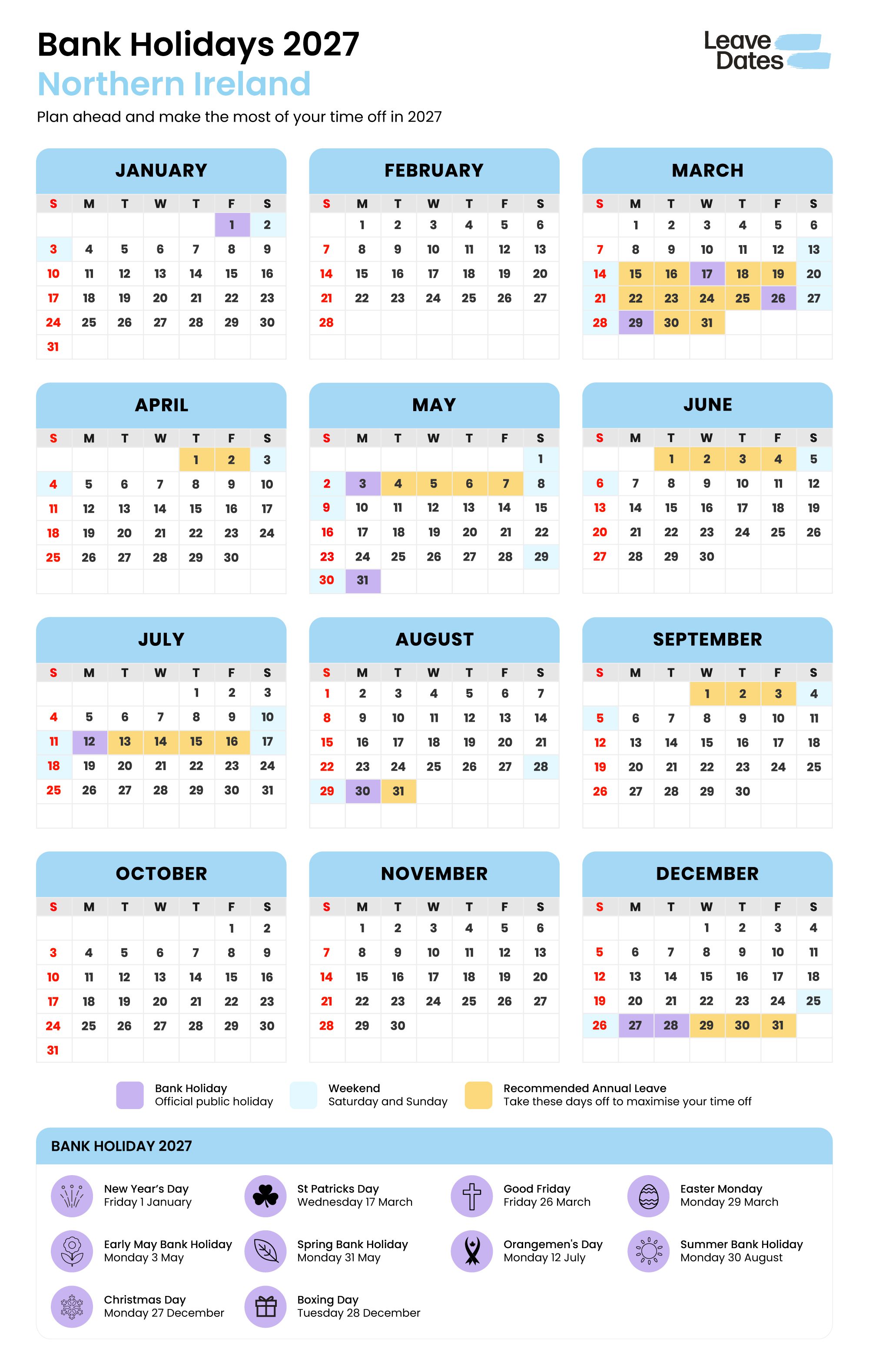
Northern Ireland has ten bank holidays in 2027:
- New Year’s Day – Friday, 1 January 2027
- St Patrick’s Day – Wednesday, 17 March 2027
- Good Friday – Friday, 26 March 2027
- Easter Monday – Monday, 29 March 2027
- Early May Bank Holiday – Monday, 3 May 2027
- Spring Bank Holiday – Monday, 31 May 2027
- Orangemen's Day – Monday, 12 July 2027
- Summer Bank Holiday – Monday, 30 August 2027
- Christmas Day (substitute day) – Monday, 27 December 2027
- Boxing Day (substitute day) – Tuesday, 28 December 2027
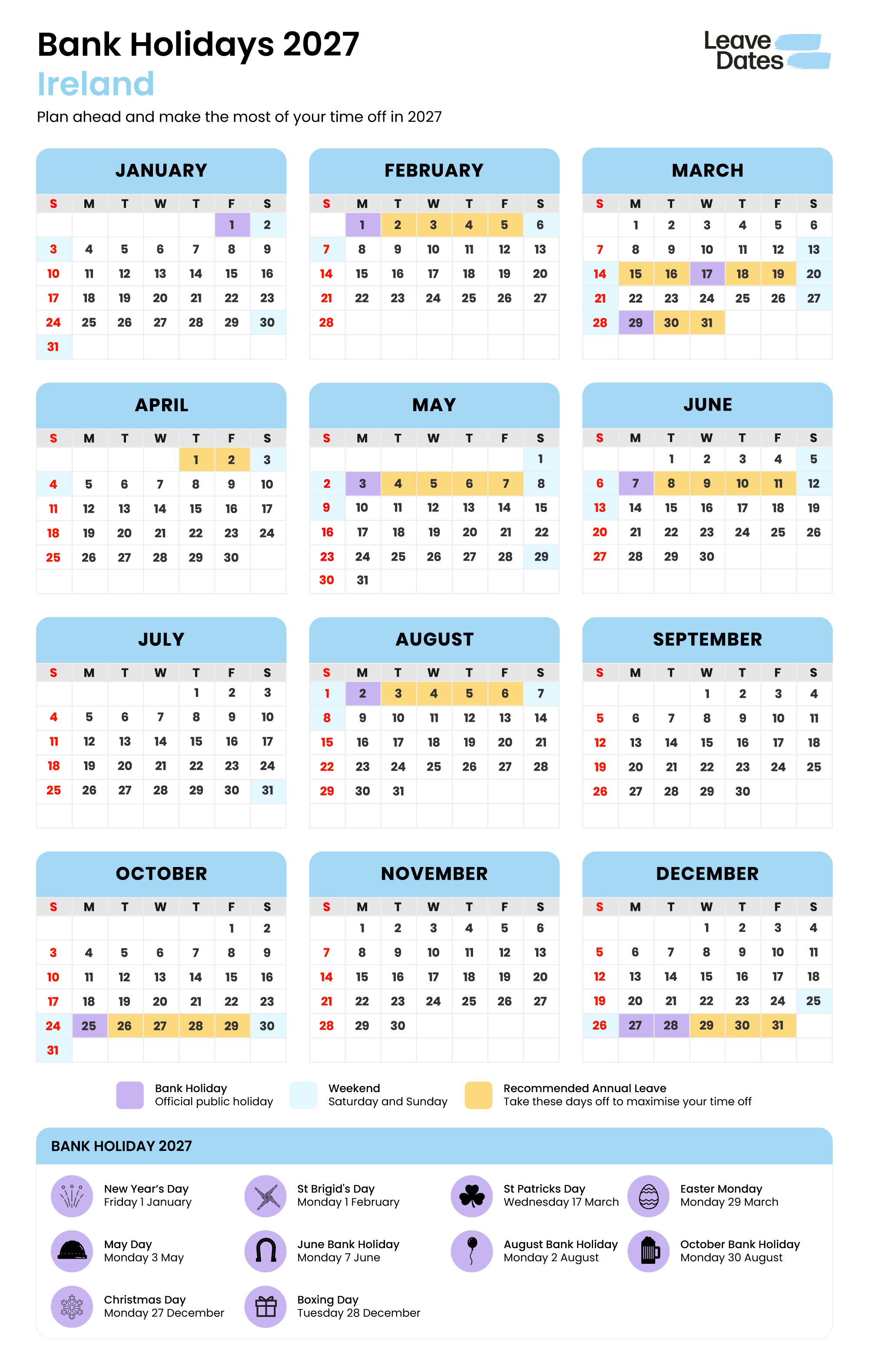
Ireland has ten bank holidays in 2027:
- New Year’s Day – Friday, 1 January 2027
- St Brigid's Day – Monday, 1 February 2027
- St Patrick’s Day – Wednesday, 17 March 2027
- Easter Monday – Monday, 29 March 2027
- May Day – Monday, 3 May 2027
- June Bank Holiday – Monday, 7 June 2027
- August Bank Holiday – Monday, 2 August 2027
- October Bank Holiday – Monday, 25 October 2027
- Christmas Day – Saturday, 25 December 2027 (substitute day Monday, 27 December)
- St Stephen's Day – Sunday, 26 December 2027 (substitute day Tuesday, 28 December)
Best times to stack leave in 2027
Easter is a big opportunity in 2027, offering a chance of 16 consecutive days if you’re in England & Wales. That’s a two-week all-inclusive with a day either side for packing and jet lag. A long weekend is enough for a staycation, but a long fortnight? We’re going long haul, baby.
Below is a snapshot of the upcoming year and the key months to look forward to.
New Year & January Long Breaks
With New Year’s Day falling on a Friday, you already get a 3-day weekend (Friday 1 January – Sunday 3 January). In Scotland, it’s four days as you also get the 2 January substitute day (an extra NY hangover day? Clever Scots).
If you book Monday 4 January to Friday 8 January (5 days, or 4 days in Scotland), you can stretch this to 10 consecutive days off from Friday 1 January to Sunday 10 January.
Spring/Easter
For the Irish, St Brigid’s Day falls on Monday, 1 February, so if you book Tuesday 2 to Friday 5 February (4 days) you’ll get 9 consecutive days off from Saturday 30 January – Sunday 7 February.
Then, the big one. The combination of Good Friday and Easter Monday creates one of the best stacking opportunities of the year.
Book Monday 22 March to Thursday 25 March (4 days) and Tuesday 30 March to Friday 2 April (4 days) to get 16 consecutive days off from Saturday 20 March to Sunday 4 April.
Note: Easter Monday in Scotland 🏴
Sorry northerners, as there’s no Easter Monday bank holiday in Scotland this one’s cut slightly short for you, but you can still book Monday 22 March to Thursday 25 March (4 days) for 9 consecutive days off (20–28 March). And you’ll make up for it later in the year.
Things get really exciting in spring if you’re in Northern Ireland, though. Because St Patrick’s Day falls on a Wednesday, book Monday 15 March, Tuesday 16 March, Thursday 18 March and Friday 19 March (4 days) for 9 consecutive days off from 13–21 March. If you do this and the Easter hack above, you’ll get 23 consecutive days off (13 March to 4 April) booking just 12 days. It’s basically a sabbatical.
In the Republic of Ireland, though, Good Friday is a bank holiday but not a public holiday, so you have to use an extra annual leave day for 26 March or your fun will be rudely interrupted.
Early May & Spring Bank Holidays
Book Tuesday 4 May to Friday 7 May (4 days) around the Early May Bank Holiday for 9 consecutive days off (Saturday 1 May – Sunday 9 May).
For England, Wales, Scotland and NI, repeat the same strategy around the Spring Bank Holiday: Book Tuesday 1 June to Friday 4 June (4 days) for 9 days off from Saturday 29 May to Sunday 6 June.
In the Republic of Ireland, yours comes later. Book Tuesday 8 to Friday 11 June (4 days) for 9 consecutive days off from 6–14 June.
Working with a global or regional team?
With Leave Dates, spotting upcoming bank holidays in 200+ countries and regions is easy. Simply load the regions you need for your team and sync with the calendars and tools you already use.
Summer & August Breaks
Book Tuesday 31 August to Friday 3 September (4 days) for 9 consecutive days off from Saturday 28 August to Sunday 5 September. Or, if you’re in Scotland, book Tuesday 3 August to Friday 6 August (4 days) for 9 consecutive days off from Saturday 31 July to Sunday 8 August.
In NI, you can also book Tuesday 13 July to Friday 16 July (4 days) for 9 consecutive days off around the Battle of the Boyne, from Saturday 10 July to Sunday 18 July.
Autumn/Winter Bank Holidays
Bank holidays late in the year are, sadly, not a thing in England & Wales or NI. But lucky folks in Scotland and the Republic of Ireland get a bonus.
In the Republic of Ireland, book Tuesday 26 to Friday 29 October (4 days) for 9 consecutive days off around the October Bank Holiday, from Saturday 23 October to Sunday 1 November.
Scots can book Monday 29 November and Wednesday 1 December to Friday 3 December (4 days) for 9 consecutive days off around St Andrew’s Day, from Saturday 27 November to Sunday 5 December.
Christmas & New Year 2027/28 Window
Christmas falls on a weekend in 2027, meaning the substitute bank holidays land on Monday 27 and Tuesday 28 December.
Book Wednesday 29 December to Friday 31 December (3 days) to get 9 consecutive days off from Saturday 25 December 2027 to Sunday 2 January 2028.
How Many Days Off Can You Get in 2027?
Short answer: loads.
If you’re using all your annual leave and only getting a few full weeks’ holiday plus some long weekends, you’re working the year on hard mode. Region by region, this is what your year could look like if you stack wisely…
Total leave stacking potential
Get 53 days off work by requesting 23 days of annual leave. More than double your leave days, not too shabby!
Get 62 days off work by requesting 27 days of annual leave – thank you St Andrew!
Get 69 days off work using 31 days of annual leave. Starting to feel a little green…
The undisputed winners, the Irish can get a huge 73 days off work by strategically booking 31 days of annual leave (some may have to be unpaid, depending on your employer’s allowance).
Leave Stacking Tips From Experts
To truly master the art of leave stacking (without P’ing off your colleagues) you need to look at the logistics of the modern workplace. These are our top tips to ensure your big 2027 holiday plans actually make it off the spreadsheet and your suitcase makes it out of the country.
Why You Should Book Early
The most lucrative anchor dates (hello Easter) will be in high demand and approval usually works on a first-come, first-served basis. For the best chance of securing them, it goes without saying you need to be earlier and quicker than anyone else.
Get into holiday mode early by channelling your inner ‘Brit in Benidorm fighting for a sunbed’ energy.
How to Avoid Leave Clashes With Colleagues
To prevent friction (and tension), transparency is key.
That means no sneaky emails to your mate in HR to fast-track approval. Using a dedicated leave management system provides a real-time visual map of who is off and when, meaning potential clashes are spotted instantly, and you can adjust your ‘stack’ by a day or two to ensure minimum staffing levels are maintained.
Checking Your Holiday Policy
Before you fire up the group chat and start booking flights, check the fine print of your contract to see how bank holidays are handled.
Some companies include public holidays within your total entitlement, while others offer them as additional days. This could change how many days you need to ‘spend’. There might also be blocked-out dates where leave is limited, such as a busy year-end or project launch.
Alternative Ways to Get Extra Time Off
If you can’t quite hit that 60-day goal, due to clashes or company policy, there are a few other ways to boost your balance. Some modern contracts allow for holiday carry-over, letting you roll unused days from 2026 into 2027, or offer a leave purchase scheme where you can buy an extra week of leave via salary sacrifice. Also check if your company offers flex days or ‘time off in lieu’ (TOIL) for overtime worked, as this could plug a gap in a long leave stack without touching your core allowance.
Leave Stacking Checklist
| Action | |
|---|---|
| Yes | Audit your balance: Confirm exactly how many days you are entitled to for the 2027 calendar year, including any confirmed carry-over from 2026. |
| Yes | Identify the key dates: Mark all 2027 Bank Holidays (including the moving targets like Easter and the May breaks) on your calendar (or check your Leave Dates wall chart). |
| Yes | Map the ‘bridges’: Highlight the 3–4 day gaps between weekends and Bank Holidays where a small amount of leave creates a 9 or 10-day block. |
| Yes | Check your contract: Check your employee handbook for any restricted dates or other rules that might cap how many consecutive days you can take. |
| Yes | Use a centralised tool: Check your leave calendar to ensure your chosen dates don’t clash with a colleague. |
| Yes | Get it in writing: Ensure all requests are formally approved in your tracking system before you start booking flights or hotels. |
Final Thoughts: Plan Smarter, Not Harder
Everybody wants more leave. Short of convincing your company to adopt an unlimited leave policy, leave stacking is your best bet. But don’t hang about, these dates will be popular so get ahead by booking your leave dates now to ensure a restful and fun 2027.
FAQs
Yes, but gains will depend on whether your scheduled working days align with the bridging dates around bank holidays.
When a bank holiday falls on a weekend, the following Monday (or Tuesday) is designated as a substitute day, providing the same ‘anchor’ for leave stacking.
Leave stacking, when you use your company’s leave management process, is a transparent use of your contractual and statutory entitlement. As long as you follow company policy and ensure team coverage, it is a perfectly fair way to manage your time off.
Outside of specific circumstances (eg parental leave), this depends on your employer's specific policy, so check for any ‘use it or lose it’ clauses in your contract.


