
In this article
Quick takeaways
- Sabbatical leave is extended, planned time away from work while remaining employed
- More than a quarter of UK companies have a sabbatical leave programme
Offering sabbatical leave helps to avoid burnout and attract/retain top talent
Sabbatical leave is more than a perk; it gives employees the opportunity to take an extended time away from work while maintaining their job security.
With a competitive talent market and ever-increasing demand for better mental health initiatives in the workforce, sabbaticals can keep talented employees growing personally and professionally, and keep them from burning out mid-career.
In this guide, we break down what sabbatical leave is, how it works in the UK and other parts of the world, and how both employee and employer can benefit from it.
What is sabbatical leave?
So what actually is ‘taking a sabbatical’? It’s one of those buzzwords we can all drop into conversation to ‘sound professional’ without really knowing what it means. Like ‘synergy’ and ‘pro rata’. Is it a holiday? Is it just the ‘French exit’ of quitting?
While the term is vague enough that it can be helpfully used to cover a whole host of situations (“John is on sabbatical” sounds a lot better than “I have no idea where or who John is”), it refers to a very specific type of leave.
The purpose and duration of a sabbatical
A sabbatical (derived from the Latin for “off on a jolly”... maybe) is a planned, extended (typically 3 months to a year) period of time away from work, agreed in advance between employer/employee, generally with the aim of personal or professional growth.
Why sabbaticals are different from regular leave
Unlike annual leave, which is shorter in duration, a sabbatical offers a unique opportunity for skill acquisition, deep rest and reflection or the pursuit of life-changing opportunities. Crucially, the employment contract remains active. The employee is guaranteed their role (or a similar one) to return to.
Implement creative custom leave policies
From birthday leave to duvet days and sabbaticals, modern businesses are using leave as an incentive to recruit and retain talent.
Leave Dates helps you implement any leave policy in a few clicks.
Start your 30-day free trial today!
Is sabbatical leave paid?
This is the big question. Typically, sabbatical leave is unpaid in the private sector, though some companies are beginning to offer partially paid sabbaticals to high performers as a perk and a way to attract and retain top talent. It could be more likely to be paid if the purpose of the leave has some direct benefit to the employee’s work.
It also depends on what you consider ‘payment’, as there are financial benefits to remaining employed.
Common reasons for taking sabbatical leave
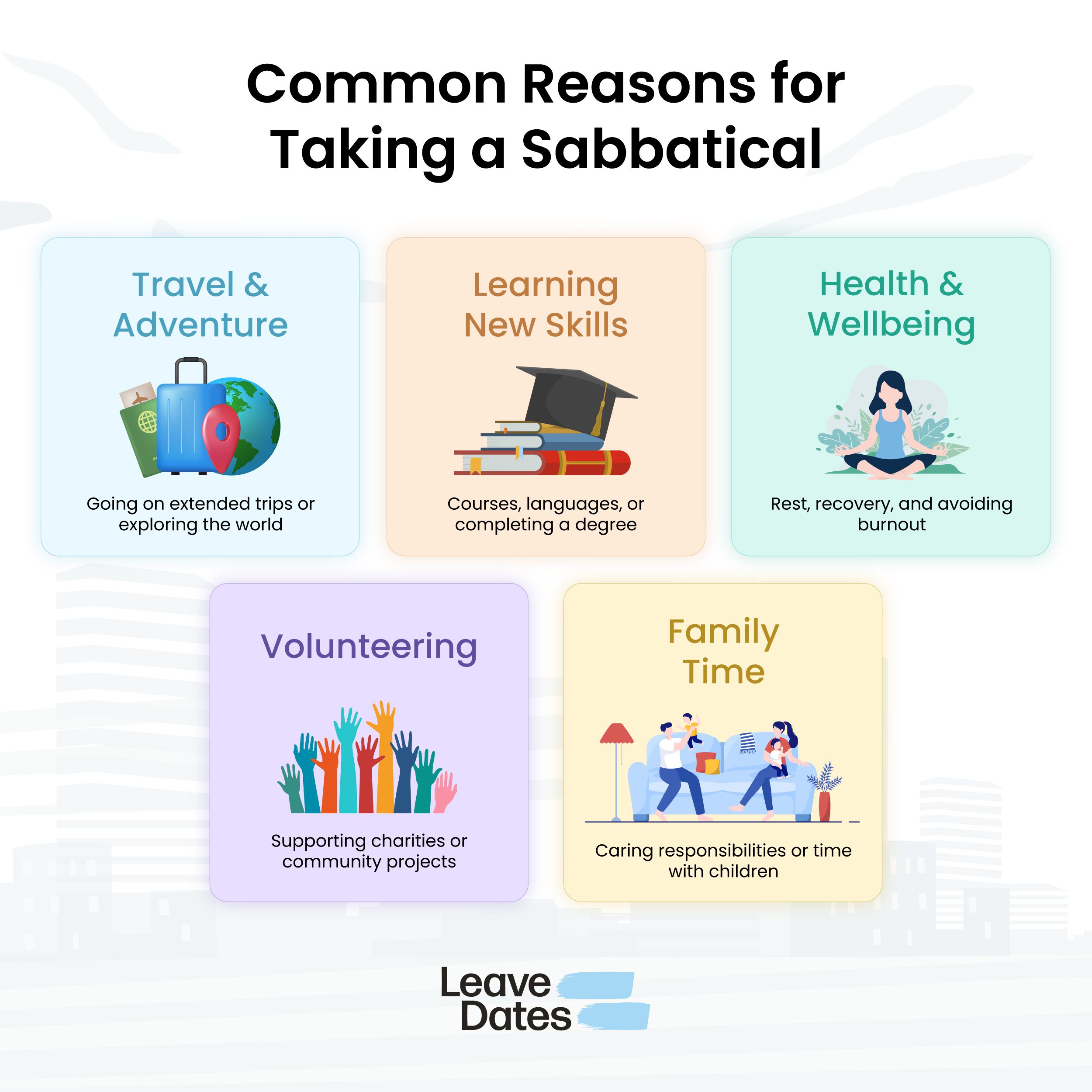
People take sabbatical leave for many different reasons, personal or professional. Most use the time to focus on big personal goals or projects that a 9-to-5 job gets in the way. Some of the most common reasons are:
- Travel and adventure: Going on a tour of the world or an extended trip.
- Learning new skills: Taking a course, learning a language or finishing a degree.
- Health and wellbeing: Taking a break simply to rest, avoid stress or recover from burnout.
- Volunteering: Spending time working with a charity or a community project, in the UK or abroad.
- Family time: Caring for a relative or spending more time with children at a key time.
Sabbatical leave trends in the UK
Once a niche perk mostly found in academic sectors, sabbatical leave is fast becoming a more mainstream talent strategy, termed the ‘grownup gap year’.
Adoption by UK companies
As of 2024, more than half of UK companies include sabbatical leave in their benefits packages, and almost 5 million Brits have already taken one. Clearly, companies are recognising that an employee who feels respected, recharged and re-energised is likely to stick around. And that’s not based on a hunch, but data.
Demand from the workforce
Nearly half (42%) of workers want access to sabbatical leave, seeing it as an antidote for burnout.
For staff, it's a chance to pursue a passion project; life goals don’t have to be put on hold to focus solely on work. For employers, they can leverage this as a powerful tool to drive long-term loyalty.
Legal status and sabbatical leave entitlements
There is no statutory right to sabbatical leave in the UK; it is a ‘discretionary benefit’ entirely dependent on your employment contract and company policy. Some public sector organisations (e.g., UK universities and the NHS) have formalised policies.
When on sabbatical, your statutory rights as an employee are preserved (e.g., continuous service), but you would typically not accrue annual leave.
Sabbatical leave rules and eligibility
As sabbatical leave is not a statutory entitlement, the rules are at the business's discretion. These should be designed to protect business continuity and be crystal clear for employees. The policy and rules should set out:
Minimum service
It’s rare for businesses to offer sabbatical leave from day one; three to five years’ continuous employment is typical for eligibility.
Performance
You might want to offer this kind of leave (or a more generous amount) as a sort of bonus or high-performance perk. As a minimum, it would generally not be available to anyone on a disciplinary or performance improvement plan.
Pro-rata
The duration and payment (if given) for sabbatical leave are usually calculated pro rata for part-time staff. Remember, let the software handle this for you. Simply add a ‘sabbatical’ leave type and input your rules.
Leave accrual
By law, all ‘employed’ workers accrue statutory annual leave of 5.6 weeks per year; this remains the default position even during a sabbatical. But a policy might require staff to sign a variation of the contract and agree to waive the accrual of contractual holiday, to avoid a huge leave balance on their return. Some companies require employees to use accrued annual leave during the sabbatical.
Sabbatical leave vs career break – what’s the difference?
The difference between a sabbatical and a career break is that if you take a sabbatical, you have a guaranteed job to go back to.
Leaving with a guaranteed role
If you take a career break, you leave your job without another one lined up. You perhaps don’t know what’s next.
Pseudo-sabbaticals and legal protections
A word of warning: ‘career breaks’ can sometimes be pseudo-sabbaticals, without the legal protections. It’s crucial that if you want a sabbatical, you ask for it specifically and formally and seek the correct legal advice to ensure your job is protected.
Verbal promises are not enough
When you take a career break, you leave employment; a verbal promise of a job to return to or a re-hire, in legal terms, means nothing. Whether or not you’re legally employed also affects things like your redundancy pay/rights
How to request sabbatical leave
A sabbatical is a big commitment on both sides, so it takes more than a quick email or a water cooler chat to arrange.
The exact process will depend on company policy, but it might look something like this:
First, you need to know it’s even an option. Check the employee handbook and your employment contract to get a good understanding of your entitlements and the process.
Timing is a key feature of sabbatical leave, and you should expect to give your employer at least 3–6 months’ notice and be prepared to agree on the exact timing and duration through discussion.
Explain how this time away will benefit the company, either directly or indirectly (e.g. “I will return with improved leadership skills/better mental health/experience of a new market/a new language”). Confirm your commitment to return to the business.
Identify who and how your responsibilities will be covered and set out a handover process/period.
What should a sabbatical leave policy include?
A sabbatical leave policy should clearly set out the company’s position on several key points:
Salary
- In an unpaid sabbatical, salary is suspended.
- In a paid sabbatical, you might pay a portion of salary (20–50%) or a flat monthly grant/stipend.
Pension
- Unpaid sabbatical: pension contributions are usually paused.
- Paid sabbatical: employer contributions may continue.
Tax
- Unpaid sabbatical: no tax payable (on this employment) during the break. Income from other sources may need to be reported to HMRC.
- Paid sabbatical: usual PAYE applies to any payments.
Benefits
- Unpaid sabbatical: health/life insurance often stay active, but most other benefits and perks (eg cycle to work, gym memberships etc) likely to be suspended.
- Paid sabbatical: Usually all benefits stay active.
Approval process and return terms
Use a formal sabbatical leave request form that outlines start date, end date and a signature to confirm commitment to return to the business. This should be submitted in writing at least four months in advance. This gives management enough time to cover for the role and key tasks and approve the dates. Once agreed, both parties should sign to confirm the return date and pay terms.
Managing sabbatical leave without disrupting work
Sabbaticals are an easy type of leave to manage because they’re predictable. You’re not going to get hit with your Head of Ops taking an emergency six-month career break starting tomorrow. Sabbaticals are intentional. They are discussed and planned well in advance, so with proactive leave management they should pose no threat to productivity. For a sabbatical to be successful, though, the employee needs to come back, ideally brighter and better than before.
Returning to work after a sabbatical
The return to work is where a lot of sabbaticals fail, and why they (wrongly) get the reputation of being a ‘soft quit’. An employee’s return from a sabbatical is likely to take place after an extended period away and so should be treated similarly to a return to work post maternity or long-term sickness. Much will have changed, on both sides, and a return-to-work interview is a great way to catch up and discuss how those changes will affect all involved.
While the employee might have to accept a different desk and their tea preferences may have slipped off the radar, they should expect the same or a similar role, otherwise the employer could be in breach of contract.
Sabbaticals around the world
Sabbatical leave, or its equivalents, is found globally. While practices differ, it’s typically seen as a major perk and often used to reward high performance or long service, pointing to its value in retention and performance-driving efforts.
Examples from overseas
Largely seen as a ‘white collar’ perk, typically in law and tech, though in fact McDonald’s was one of the first companies to offer a sabbatical leave programme in the late ‘70s.

Unique ‘long-service leave’ laws mean employees in many states can take extended paid leave after a certain period with the same employer, typically 7–10 years.

Some countries (e.g., Belgium) offer ‘time credits’ for career breaks, with a small allowance paid by the government under specific conditions.

Key considerations for employers
Sabbaticals are on the up. And, understandably, with significant benefits for employers and employees alike. They help to reduce stress and burnout, increase wellbeing, and facilitate the acquisition of new skills and experiences.
A win-win for all. By understanding the rules and planning carefully, you can confidently offer sabbaticals as an enticing perk in a competitive employment landscape.
FAQs
In most cases, no. As long as there is an agreement (ideally in writing) that your contract remains active, your period of continuous service is preserved. This is a crucial difference between a sabbatical and a career break.
This depends on your contract. We always recommend seeking legal advice on your individual circumstances, as many sabbatical policies require staff to sign a variation of contract agreeing to waive the accrual of contractual holiday.
Yes. Unless your employment contract explicitly states that you have a guaranteed right to a sabbatical after a certain period, it is a discretionary benefit. An employer can refuse a request based on ‘business grounds’.


