In this article
Quick takeaways
- The Early May bank holiday is on Monday, 4th May 2026, creating a long weekend at the beginning of May.
- This holiday is observed across the UK in England, Wales, Scotland, and Northern Ireland.
- Extend your days off by booking annual leave in the working days between the holiday and the following weekend.
What is the Early May Bank Holiday?
Historical significance
Introduced as a bank holiday in 1978, and often referred to as May Day, the Early May Bank Holiday has a long history rooted in ancient spring festivals and the arrival of warmer weather.
Over many centuries, the time of year was marked by the Roman Floralia and the Celtic Beltane, which celebrated nature, fertility, and the seasons’ changes, and was famously symbolised by the Maypole.
Modern celebrations
Today, the Early May bank holiday is more about enjoying time off with loved ones, and is a great opportunity for short trips and staycations, spending time outdoors and joining in fairs in the community.
When is the Early May Bank Holiday in 2026?
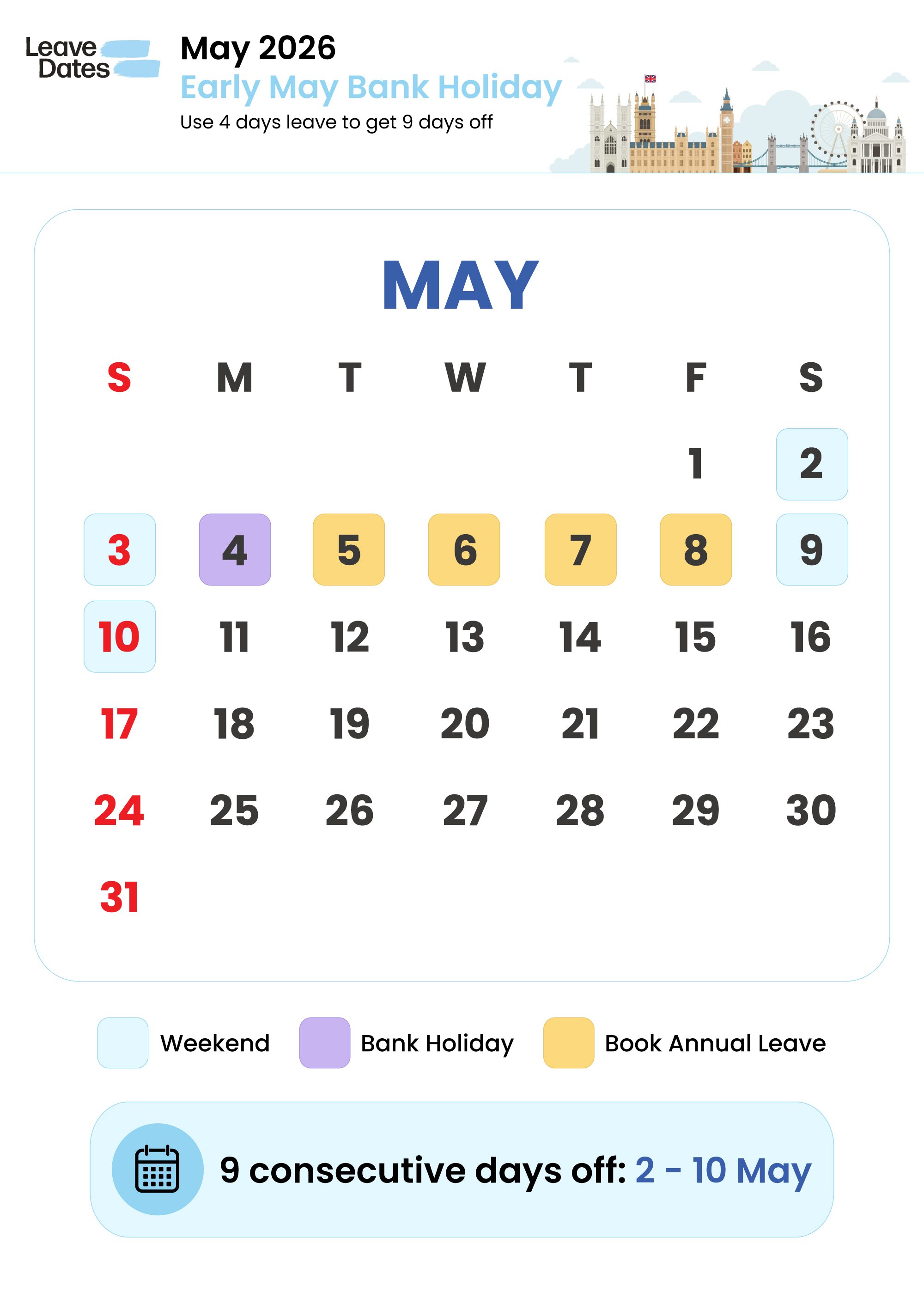
This year, the holiday falls on Monday, 4th May 2026. Creating a three-day weekend with:
- Saturday, 2nd May
- Sunday, 3rd May
Who gets time off for the Early May Bank Holiday?
The Early May bank holiday is observed across the entire UK; England, Wales, Scotland and Northern Ireland. Most full-time employees will have this day off, while part-time workers typically receive a pro rata entitlement; however, this may depend on your employment contract, so it’s best to check.
Some industries, such as retail, hospitality, healthcare, and emergency services, typically roster staff over bank holidays, which may entitle them to time off in lieu or overtime pay.
How to get more time off around the Early May Bank Holiday
This bank holiday weekend is a great chance to stack leave, especially if you didn’t get any extra time off over Easter.
If you typically get weekend days off, here’s how you can maximise your annual leave in May:
- Request leave from the 5th-9th May (inclusive)
- Once approved, the 4 annual leave days equal 9 consecutive days off.
This neat trick gives you a full break spanning two weekends, using minimal annual leave entitlement.
Managing bank holidays with multi-regional teams
If your team operates across multiple countries, keeping track of bank holidays can get complicated, and important dates can be easily forgotten.
With Leave Dates, you can:
- Load bank holidays to your company calendar for any country or region
- Sync leave calendars and business tools.
- Plan staffing levels more effectively
- Create leave limits to avoid scheduling clashes
- Access the information you need, anytime, on desktop or our mobile app.
Sit back, relax, and let us calculate your leave.
Leave Dates automatically calculates all your staff leave — no spreadsheets, no manual maths, just accurate data at your fingertips.
How to manage leave during peak periods
Bank holidays often create spikes in leave requests.
To maintain coverage:
- Set clear leave limits across teams or departments.
- Encourage early booking
- Use a leave management system, like Leave Dates, to track availability.
This ensures fairness while keeping your business running smoothly.
How to add and track bank holidays in Leave Dates
Final thought
Taking time off over the Early May bank holiday weekend is a great chance to pause, reset, and enjoy the beginning of the warmer months.
If you’re planning a trip, spending time with family, or taking time to rest at home, planning some leave after the Early May bank holiday will help you make the most of your annual leave.
Book early, avoid peak travel times, and stack your annual leave to reward yourself with a long and stress-free spring break.
FAQs
Monday, 4 May 2026
The Early May Bank Holiday creates a three-day weekend from Saturday 2 May to Monday 4 May.
Yes, it is a bank holiday observed across the UK (England, Wales, Scotland, and Northern Ireland), with most businesses and schools closed.
It has roots in May Day traditions and International Workers’ Day, celebrating both the arrival of spring and the contributions of workers, though today it’s widely enjoyed as a leisurely long weekend.