
In this article
Quick takeaways
- Annual leave is personal, flexible time off that you must request and book in advance
- Bank holidays are fixed national dates and often (but not always) given as paid time off
- How bank holidays are paid – taken from your annual leave allowance or not – is a contractual issue
A day off is a wonderful thing. A week off? Even better. But what if it’s a day off you didn’t ask for – does it still count? A day off is a day off, right?
When you’re dozing the morning away instead of fighting for your life on a packed train, it may not seem like it matters whether it’s annual leave or a bank holiday – it’s just a different colour on the wall chart, who cares? While you might assume it’s ‘just an admin thing’, the type of leave you’re taking impacts planning, pay, and leave balances, so it’s important that staff and managers know the difference.
Navigating the various types of leave can sometimes feel like a puzzle with lots of pieces, some of which look very similar. This article gives you a big piece of the overall picture by explaining the difference between annual leave and bank holidays in the UK. Consider this your essential guide to UK leave types explained.
What is annual leave?
Annual leave is your statutory holiday entitlement, and is paid time off that all employees are entitled to and accrues over the year. This is your time to (request to) take whenever you want, to do whatever you want – no explanation needed. In the UK, the law sets a minimum amount of paid annual leave:
· For full-time workers, it’s 5.6 weeks per year. Working a standard 5-day week, this works out as 28 days.
· For part-time workers, the same entitlement applies but is calculated pro rata. For example, if you worked 3 days a week, then 3 x 5.6 = 16.8 days annual leave.
· For those working irregular hours, holiday entitlement is accrued at 12.07% of hours worked.
Annual leave has several key features that distinguish it from other types of leave:
· Paid: The big one. Annual leave is fully paid at your usual salary/hourly rate. So you can take a week off without taking a hit to the wallet.
· Flexible: Annual leave has high flexibility – it can be taken at any point in the year, for any purpose.
· Requested: Unlike some forms of leave that are time-sensitive or urgent in nature, annual leave must be planned for in advance. You request your preferred dates and these are approved or denied, subject to business needs.
· Carry-over: Generally, statutory leave must be used within the current leave year, but up to 1.6 weeks/8 days can be carried over in some cases (eg where not used due to sickness or parental leave). For annual leave beyond the statutory, the option to carry over will depend on company policy.
Top tip for employees: Get your leave requests in early for a higher chance of approval, especially if you’re hoping for popular dates, such as during school holidays or either side of bank holidays (also known as ‘leave stacking’).
Top tip for employers/managers: Encourage employees to book time off throughout the year to avoid a rush near the end of the leave year
Leave management software is the most efficient way to manage multiple leave types, avoiding clashing leave dates, and get a visual overview of staffing levels throughout the year.
Bank holidays – what’s the deal?
Bank holidays are fixed national days off spread across the year given to most employees – but not everyone, as many workplaces, especially in retail, hospitality and essential services stay open. Examples include Christmas, Easter and everyone’s favourite – the May bank holiday(s). It’s where we get those lovely long weekends from.
Bank holidays can make leave planning tricky, with regional variation in the number and date of our national holidays, and plenty of businesses still needing staff (though you might get extra pay or time off in lieu).
The key features of bank holidays are:
· Fixed: Bank holidays fall on set days throughout the year, so there is no need to request them as time off, but if they’re given on top of your annual leave you can’t take these days at any other time.
· Not automatic time off: While many businesses close on bank holidays and so must give their staff the day off, there’s no legal right to bank holidays as paid leave.
· May fall under your holiday entitlement: Companies can choose whether to count bank holidays as part of your statutory paid leave.
Top tip for employees: Consider leave stacking – booking your annual leave around set bank holidays – to make the most of your leave allowance, especially if bank holidays are included. Booking the right dates can turn a couple of days’ leave into a week off!
Top tip for employers/managers: Avoid confusion by clearly stating in contracts and staff handbooks whether statutory bank holidays are included in annual leave or offered as extra days. Offering these as extra is a nice perk that might boost recruitment/retention efforts…
For reference, the bank holiday dates for the UK in 2026 are:
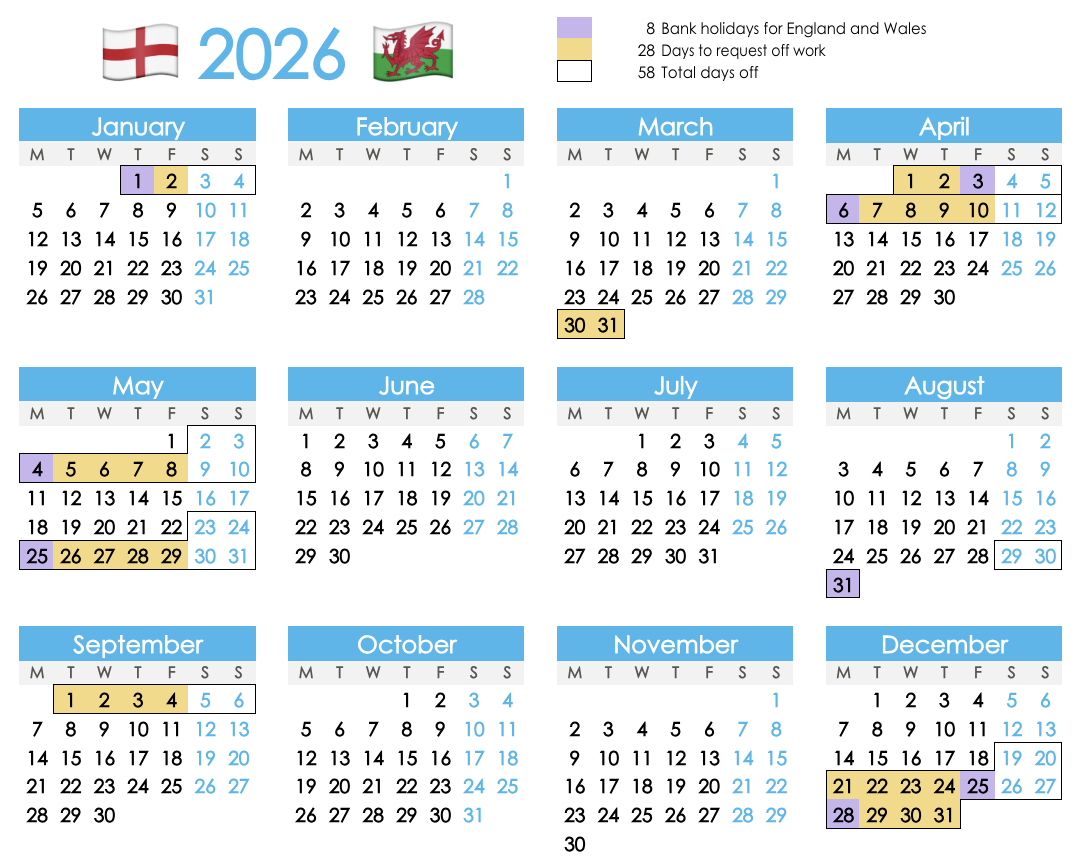
|
|
How bank holidays affect annual leave
The big question is around leave allowance. Bank holidays are always paid, but whether or not they’re paid as an extra day off or as part of your annual leave allowance, is up to your employer. It may not be all or nothing, either – many will offer Christmas and New Year dates paid time off as standard, but not the spring/summer bank holidays.
It’s a pretty big perk if you get bank hols as an add-on, so employers looking to attract and retain top talent might well consider this as a recruitment strategy. As the example below shows, it’s equivalent to more than a week’s extra leave, around a 25–30% bump. Not bad going!
· Scenario A - Bank holidays included in annual leave: English employee has 28 days leave, 8 days are pre-determined, leaving 20 days of ‘personal’ annual leave to book.
· Scenario B - Bank holidays on top: English employee has 28 days personal annual leave to book, plus 8 days determined paid leave on bank holidays – a total of 36 days’ paid leave.
How does annual leave and bank holidays affect part-time employees?
For part-time workers, generally a pro rata approach is taken to ensure fairness with bank holidays. For example, in a company that offers paid bank holidays on top of annual leave, if a part-time employee never works Mondays they shouldn’t be penalised. Instead, they should receive a pro rata entitlement for bank holidays that can be taken on days that they are contracted to work.
Key takeaways
In summary, there is a difference between annual leave and bank holidays in the UK. A few differences actually:
| BANK HOLIDAY | ANNUAL LEAVE |
Purpose | Fixed national days of observance, set by the government and not flexible. | Personal time off for rest and enjoyment, at the request of the employee at a time of their choosing. |
Entitlement | Typically 8 days in England & Wales, with extra days in Scotland and NI. | A minimum of 5.6 (28 days) for full-time workers; pro rata for part-time; 12.07% accrual for irregular hours. |
Flexibility | None, fixed dates nationally. | Highly flexible within the leave year, with potential for some limited carry-over. |
Guaranteed time off? | No. No legal requirement to offer days off on bank holidays. | Yes, if requested and approved and barring exceptional needs. |
Payment | If given off, these days are paid but may or may not be deducted from the employee’s personal leave allowance. | Paid time off, coming out of the employee’s personal leave allowance. |
So while they might look the same from the beach/park/bed, depending on how you choose to spend them, bank holidays are much less flexible than annual leave. Overall,


