
In this article
Quick takeaways
- Depending on how bank holidays fall, most months contain 20 to 23 working days.
- As bank holidays vary month-to-month, they have the most significant impact on working days in a month.
- Teams that plan leave strategically, by using a leave management system like Leave Dates, have the best chance of balancing long months.
How long is a working month, really?
Time is such a slippery, elastic concept. It drags on forever during meetings (ever heard of email?!) yet slips through your fingers like sand from the beach when you’re on holiday. Even so, we must rely on a commonly agreed measure, rather than our own personal body clock, to organise our lives, work and days off.
Nowhere does the malleability of time seem starker than when thinking about the month ahead. If you’ve made the most of our leave-stacking article and nabbed yourself a nice long Easter break for 2026, you could be skipping out the door chirping, “See you next month!” on 11th April.
As a result of some subjective elasticity, plus our penchant for bank holidays and a somewhat awkward calendar, some months seem endless and others fly by. This leaves us scratching our heads and wondering: what is a day? A month? A year? Does time even exist? Who are we, really?
Let’s pin it down, shall we? How many working days are in the average month?
What is a working day?
Before we dive in, we need to pin down a key concept: the working day. This used to be an easy thing to define: Monday through Friday, usually 9–5 or thereabouts – daylight hours basically, with a bit either side to eat, get ready and generally faff about. It would be spent at a ‘place of work’, whether an office or other ‘site’.
Now times have changed somewhat, with WFH, shift work, the gig economy and flexible work, where schedules are less standard and your ‘place of work’ could be the local coffee shop, kitchen table, sofa, bed… For the sake of simplicity though, we’re going to use your ‘conventional’ working week – so five working days, no weekends or public holidays.
The working days in the average month
A ‘calendar month’ can have between 28 and 31 days. A ‘working month’ is a different beast entirely. The theoretical maximum (assuming a five-day week) is 23 working days, but in reality this is rare, due to bank hols and irregular distribution of weekends.
As you’ll know from our previous post, bank hols are the big disruptor/gift here. In the UK, we have a good few bank or public holidays that can shorten the working week and, thus, month. Christmas, Easter and New Year’s Day are all widely observed and many employees will automatically have the day off. The total number of bank holidays varies across the UK:
- England and Wales – 8 bank holidays per year
- Scotland – 9 bank holidays per year
- Northern Ireland – 10 bank holidays per year
- Ireland - 10 bank holidays per year
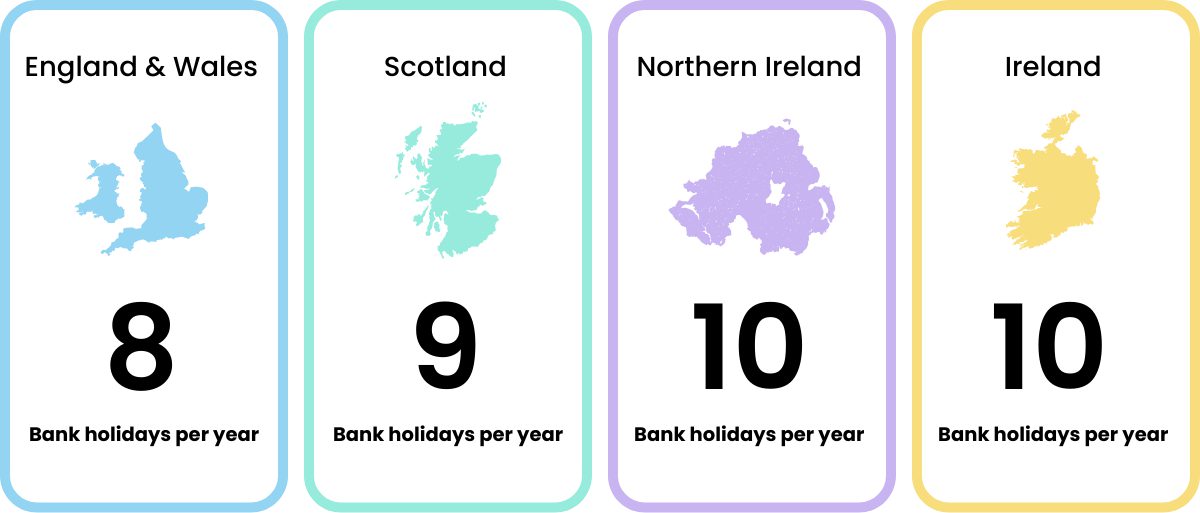
These holidays aren’t evenly distributed across the year or the months, meaning some months feel much shorter than others, work-wise.
January to December Breakdown
January
- Days: 31
- Weekends: 4 (8 days)
- Bank hols: 1 (2 in Scotland for Hogmanay)
- Working days: 21-22
January starts off hard with close to the maximum number of working days for a month, and an extra for our friends up in Scotland. For many, there’s a longer stretch to payday after a Christmas bump. With the post-festivities slump, the cold weather and lack of daylight, no wonder it can feel like the longest month of the year!
February
- Days: 28 (or 29 in a leap year)
- Weekends: 4 (8 days)
- Bank holidays: 0 (1 in Ireland)
- Working days: 19-20 (20-21 in a leap year)
Ah, the blessed relief of February. Even with no bank hols in the UK, it’s short and sweet, hurrying us towards those longer days. Ireland celebrates St Brigid's Day at the start of the month.
March
- Days: 31
- Weekends: 5 (10 days)
- Bank hols: 0 (1 in NI and Ireland for St Patrick’s Day)
- Working days: 20-21
At the end of March, British Summer Time begins! Finally, an increase in daylight hours means we’re not arriving at and leaving work in darkness, so even in a longer month in terms of working days, you might feel like you’ve got more time for yourself.
April
- Days: 30
- Weekends: 4 (8 days)
- Bank hols: 2 (1 in Ireland)
- Working days: 20-21
April gives us the first of our most-treasured traditions – the long weekend. Easter arrives. Use our leave stacking tips and you can turn that four days into… 16!! That’s less a working month than a brief stop-in to say hi on your way to and from the airport.
May
- Days: 31
- Weekends: 4.5 (9 days)
- Bank hols: 2 (1 in Ireland)
- Working days: 20-21
That half a weekend is more than made up for by the second month in a row of a double bank holiday. At this point, you’re starting to forget you even have a job. There’s a reason everyone loves May. It’s the perfect chance to nab a short getaway by tagging some annual leave onto either side of a bank holiday – one at either end of the month means there shouldn’t be too much argument over the leave calendar either!
June
- Days: 30
- Weekends: 4.5 (9 days)
- Bank hols: 0 (1 in Ireland)
- Working days: 20-21
After the heady delights of April and May, it’s back to the grind in June. Well, we can’t really complain, can we? At least we’re all feeling rested and refreshed, and the days are longer and warmer, giving you plenty of time for after-work and outdoor activities.
July
- Days: 31
- Weekends: 4 (8 days)
- Bank hols: 0 (1 in NI)
- Working days: 22-23
And here it is, the longest working month of the year. Ouch. Luckily, July is when lots of us take a summer holiday, so if you get your leave booked in early you can dodge this one! Leave it too late and you could be sweating away at your desk relying on dodgy air con rather than a nice Mediterranean breeze to keep you cool.
August
- Days: 31
- Weekends: 5 (10 days)
- Bank hols: 1 (Summer Bank Holiday)
- Working days: 20
The sun is shining, the kids are off school and we’ve got five weekends – one of them a long one. This is peak summer, no one is in the mood to work anyway, and luckily the 2026 calendar is giving us plenty of time for BBQs, festivals and outdoor fun before we head into the final stretch of the year.
September
- Days: 30
- Weekends: 4 (8 days)
- Bank hols: 0
- Working days: 22
The ‘real’ new year for geeks, Type As and Libras, we’ve got ultimate back-to-school vibes in 2026 with 1st September falling on a Tuesday and plenty of working days to throw all that motivation at.
October
- Days: 31
- Weekends: 4 (8 days)
- Bank hols: 0 (1 in Ireland)
- Working days: 22-23
Halloween not a bank holiday?! Shocking, but true. The transition to autumn is well and truly complete, and it’s another big work month. But don’t despair, as festive lights, and echoes of Mariah Carey are beginning to glint over the horizon, with just one more month to get through before we all collectively lose our minds…
November
- Days: 30
- Weekends: 5 (10 days)
- Bank hols: 0 (1 in Scotland)
- Working days: 19-20
In the month that hosts Bonfire Night, the spirit of rebellion is in the air as the weather gets colder and those familiar but ever-shrinking tubs of Celebrations start piling up in Sainsburys (let’s be real – they’ve been there since August).
If you’re anything like us, you’re saving your leave to really make the most of the Christmas/New Year break, so November is a month to be got through. Luckily, for the Scots, they end the month with St Andrew's Day and a long weekend.
December
- Days: 31
- Weekends: 4 (8 days)
- Bank hols: at least 2 (Christmas Day, Boxing Day)
- Working days: 21
Christmas and the end of the year arrive. Technically, in 2026, you’ve still got 21 working days, but many workplaces will be shut from before Christmas and into January. If you’re lucky and/or clever with your annual leave, you could be off from the 19th and enjoy just 14 working days in December 2026.
It’s also the month where time truly loses all meaning with the arrival of ‘twixmas’, a delightfully slow and gloriously confusing period of time (supposedly a week, but with no days of the week, no set meal or bed times and only pyjamas being worn, where’s the evidence?) between Christmas and New Year.
Fortunately, there’s a big bell and lots of fireworks to wake us all up and let us know when 2026 begins.
Working with a global or regional team?
With Leave Dates, spotting upcoming bank holidays in 200+ countries and regions is easy. Simply load the regions you need for your team and sync with the calendars and tools you already use.
So what’s the conclusion?
On average, employees in the UK can expect 20–23 working days in most months, depending on bank hols and where the weekends fall. Those months can feel very different though. Some long months are packed with interruptions (looking at you, May and December), while shorter ones (on paper) can drag on and on due to a solid block of work (June) and/or a lack of daylight (February and March).
If you feel like the month is dragging, or you struggle in the colder, darker months, consider leave stacking to make the most out of your breaks. Or, plan (and book) out all your annual leave in advance , so that you make up for the uneven spread of bank hols by gifting yourself some days off in the more work-intensive months. If all else fails, draw a nice big heart around those precious bank holidays so that you’ve always got something to look forward to.
FAQs
Due to the varying number of bank holidays through the year, and the region of the UK you are based in, there are between 20 and 23 working days in a typical month.
Not all months have bank holidays, so they do not always reduce the number of working days.
You can maximise your time off in the UK and Ireland in 2026 by using our leave stacking guide. With a few clever tricks, you can plan leave around Easter and Christmas to make the most of your annual leave allowance.


