
In this article
Every autumn, a clock starts ticking. No, we’re not talking advent calendars, but a rather more lacklustre countdown: to the end of the leave year.
For those in HR, late November means watching untaken leave balances with the dread of a parent eyeing a child who plans to finish the whole advent calendar by 8am on 1st December. A selection box binge ends in a stomach ache and a nap. An annual leave binge ends in empty offices, missed deadlines and stalled projects. Not very festive.
It has long been assumed that unless you enforce a strict ‘use it or lose it’ countdown, carried over leave will accumulate, creating ever greater potential for bottlenecks. But we’ve got good news: the data doesn’t support this. In fact, 9 in 10 employees actually use carry-over days before they expire.
So rather than having to send nagging “tick-tock…” emails or staff cramming their leftover leave into the last few weeks of December, a sensible carry-over policy spreads it out more calmly.
How common is carry-over leave, really?
Before looking at how they’re used, it’s useful to know how ‘normal’ it is to have a carry-over leave policy in UK workplaces, and how minimal their business impact actually is.
- 54% of employees can carry over some leave
- Around 24% of them actually do it
- The median amount carried over is 4 days
- For the vast majority of employees (~85%), total annual leave use consists of base entitlement only, with nothing carried over
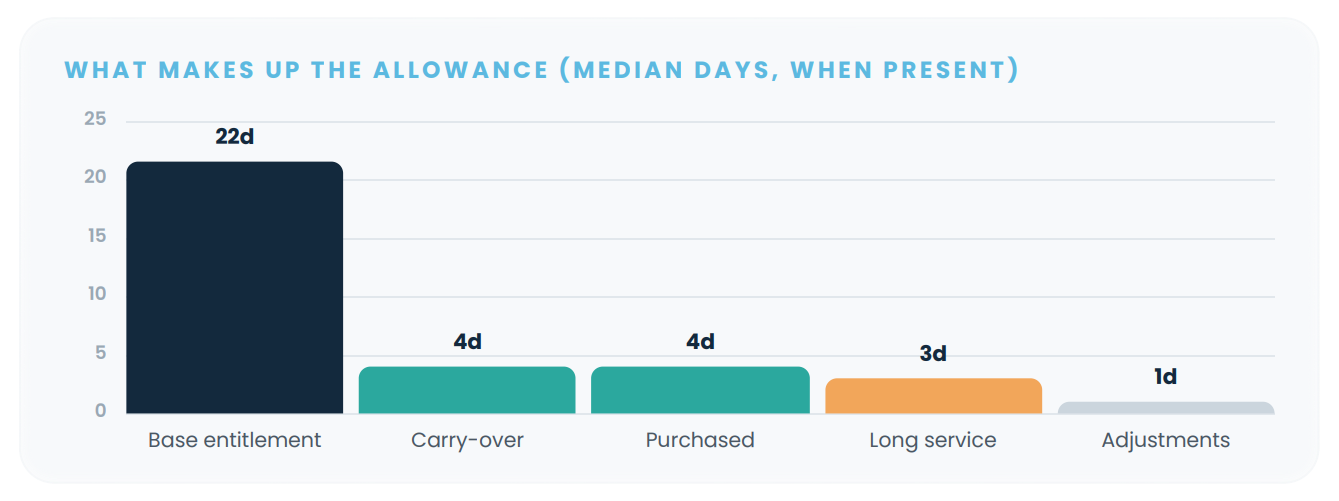
So if you’re worried that letting people carry over holiday to next year will mean it snowballing into an avalanche of unused leave ready to fall on you in the next financial year, you can breathe easy: the data doesn’t support this.
In reality, less than a quarter of your workforce will actually end up using the feature in any single year, and those who do only roll over a handful of days. Far from the unmanageable liability many leaders fear.
The most reassuring stat
While all of the data points to a far less scary picture than the words ‘carry-over leave’ might conjure, the real myth-buster is this one:
Roughly 9 in 10 employees (90%) who carry days over do use them before they expire.
So it’s doing what it’s supposed to do: giving a small number of people a short extension to avoid losing their earned leave. There’s no snowball mounting, and no expired annual leave vanishing into thin air, leaving frazzled and burned-out employees behind.
This fundamentally changes how we should talk about unused annual leave UK trends. Rather than warning leaders and managers about time-off deficits and a systemic leak in carry-over leave expiry – a non-issue, as we know this isn’t happening at scale – we can focus our attention on the workers who don't book any leave at all.
From threats to trust
The big implication of this stat is that it exposes a flaw in how workplaces have historically talked about rest.
If you rely on traditional ‘use it or lose it’ framing when talking about annual leave, it relies on threat-based motivation: Book your days by X date, or we will take them away. It treats annual leave as an admin task hanging over the employee’s head rather than a treat to be savoured and consumed at exactly the right moment to give maximum enjoyment.
The data reveals that you don’t need to threaten staff into taking their leave or fret about implementing a carry-over policy. Employees aren’t recklessly hoarding time or panicking at year-end; they are simply managing a valuable personal resource with intention. Rather than a source of risk, carry-over is a proactive, trust-led mechanism that gives staff autonomy and agency over their time off. You do not need to worry about it.
What a ‘normal’ carry-over policy looks like
If you’re currently reviewing your annual leave carry-over rules, you might want to know how your policy compares to UK norms. Are you being too strict, or too lax? What do UK workers expect?
Our benchmarking data shows a clear, industry-wide consensus on what is ‘standard’ policy:
| Policy metric | Benchmark |
|---|---|
| Capped vs uncapped | 99% of policies are capped. Almost no one allows uncapped carry-over leave. |
| Maximum cap days | By far the most common cap is 5 days (in 43% of policies), though some (21%) allow up to 10 days. The overall median is 6 days. |
| Expiry rules | 73% of policies set a specific expiry date for carried-over days to be used by. |
| Expiry window | The standard is 3 months (47% of policies), with some allowing longer windows (7% allow 6 months, 13% allow 12 months). |
So if your policy caps rollover at 5 days and requires staff to use those days within the first 3 months of the new leave year, you can ignore any accusations of being ‘harsh’ – you’re right in line with the clear market standard.
Carry-over as a December release valve
Beyond giving people flexibility and agency, carry-over plays a vital operational role that makes a December binge less likely:
When we compared booking patterns between companies with and without carry-over options, there was an obvious finding:
- Employees without carry-over available take 16.1% of their total annual leave into December.
- Employees with carry-over options use noticeably less leave in December (13.5%).
When workers know that a few unused days can roll over safely into Q1, they don't feel forced to cram it all into the final three weeks of the year. As well as preventing lost days, an annual leave rollover policy smooths out seasonal bottlenecks, protecting team coverage and operations during what, for many, is the busiest month of the year.
So what should managers actually focus on?
Because we can see that carry-over works well as a policy, there’s no need to waste time on over-engineered policy overhauls. Instead, focus on a few easy but high-impact actions:
- Change the tone: Ditch the passive-aggressive ‘tick-tock’ deadline warnings. Frame carry-over communications around proactivity, flexibility, better workload distribution, and well-deserved rest.
- No fix needed: If your current policy aligns with our benchmark, leave it as it is. The data shows this setup works well, balancing flexibility with predictability to serve both employee and employer.
- Use carry-over to tame year-end crunches: If your business struggles with big staff shortages every December and doesn’t currently have a carry-over policy, introducing a modest 3-to-5-day allowance could relieve year-end pressure without creating a huge leave backlog.
To sum up, carry-over leave is really a non-issue. Far from the big scary monster of your HR nightmares, carry-over leave is harmless - a good thing, even. A little grace period so that you don’t punish your hard-working team for being too busy to book their leave, and a small, low-impact action that will go a long way towards protecting staff wellbeing. It also gets you away from threat-based (‘use it or lose it!’) year-end panic to a trust-led culture of ‘waste not, want not.’ Much more festive
Curious about how your company’s leave habits compare to industry benchmarks? Explore the full research report to discover more data-backed insights, or see how Leave Dates simplifies carry-over tracking, policy customisation and leave management for modern teams.
FAQs
Standard UK statutory leave (5.6 weeks) has specific rules, but employers can set contractual rules for leave beyond statutory limits, or allow statutory carry-over under specific legal conditions (such as long-term sick leave or family leave). In practice, benchmark data shows 43% of UK employers cap voluntary contractual carry-over at 5 days, with an overall median cap of 6 days.
Yes. Overwhelmingly so. Benchmark data shows that 9 in 10 employees who carry leave into a new year end up booking and taking those days before any expiration deadline passes.
The standard benchmark across UK businesses is 3 months from the start of the new leave year, which is used by 47% of organisations that enforce an expiry deadline.
Yes. Offering a modest carry-over policy reduces the amount of annual leave concentrated in December from 16% to 13.5%, helping distribute leave requests more evenly across the calendar and avoiding year-end short-staffing.


