
In this article
Quick takeaways
- In the UK, eligible employees can take up to 52 weeks’ statutory adoption leave
- Statutory adoption leave is paid for up to 39 weeks
- Only one adoptive parent can take adoption leave, but shared parental leave is still available
Adoption leave in the UK is a statutory right that entitles eligible employees to time off when they adopt a child. This guide explains how adoption leave works, including eligibility, adoption pay, timelines, and parental leave for adoption options.
For many UK employers, adoption leave may be uncharted waters. But as your company and so your teams grow, you will see increasingly diverse lifestyles and family setups that, as an inclusive and compliant employer, you must cater for in your leave policies.
Adoption leave may come up less frequently than maternity or paternity leave, and it does have some key differences, but that’s no reason to dread the admin. This guide provides a clear framework for building an adoption leave policy, calculating statutory pay and managing the leave itself.
What is adoption leave?
Adoption leave allows an employee to take up to 52 weeks’ leave from work when they adopt a child. As such, all employers are required to offer it.
As adoption doesn’t always coincide with birth, the dates can be less clear cut than maternity/paternity (though any 42-weeks-pregnant woman will likely laugh at this!). It can be taken on the day, or up to 14 days before, the child begins living with the employee (the ‘placement date’); or, when an employee has been matched with a child to be placed with them.
Adoption leave is split into two 26-week periods:
- The first 26 weeks is known as ‘ordinary adoption leave’ (OAL)
- The second 26 weeks is called ‘additional adoption leave’ (AAL)
As with maternity leave, statutory pay is available for 39 of the 52 weeks of leave.
Adoption leave UK eligibility
There are two sets of criteria that need to be met to qualify for adoption leave in the UK: one for the time off itself, and the other for pay.
Eligibility for adoption leave
As of 2026, almost all employees are entitled to take the full 52 weeks of adoption leave from day one of their employment. There is no minimum service length to qualify for taking this time off. To be eligible, the person simply needs to:
- Be an ‘employee’ (i.e., not freelance or a contractor)
- Be matched with a child by a recognised adoption agency
Eligibility for statutory adoption pay
To qualify for paid leave, which, like maternity pay, covers 39 weeks, the employee must meet the same requirements as one would for maternity pay:
- Minimum continuous service for 26 weeks prior to being matched with the child
- Minimum earnings of £129 per week (on average) in an 8-week relevant period
- Correct notice and documentation provided (a ‘matching certificate’)
How long is adoption leave
The total amount of adoption leave someone can take is 52 weeks. Because it is split into two blocks (OAL and AAL), your payroll and leave calendar will need to track these separately. It’s important that it does, because this impacts the employee’s ‘right to return’ protections.
- OAL: In the first 26 weeks of adoption leave, the employee has the right to return to the same job
- AAL: In the second 26 weeks, the employee has the right to return to the same job or a comparable role with the same pay and conditions
Employees can start adoption leave up to 14 days before the placement date. But there can be just as much uncertainty around dates with adoption leave as there is for a pregnancy and maternity leave, so employers should be flexible and prepared for short-notice changes.
Payroll process for adoption pay in the UK
Calculating Statutory Adoption Pay (SAP) is very similar to the process for maternity leave, but there is scope for error due to the various rates for different time periods. Here’s a breakdown for payroll:
Statutory adoption pay (SAP)
- Weeks 1–6: 90% of the employee’s average weekly earnings
- Weeks 7–9: £194.32 per week (or 90% of average weekly earnings, whichever is lower)
- Weeks 40–52: Unpaid (unless the company chooses to offer any enhanced paid parental leave)
Example adoption pay calculation
So what does the above look like in practice? Let’s take an example. If an employee earns £45k per year (which works out at £865.38 per week), then the three periods of their (statutory) adoption leave are paid as follows:
- First 6 weeks: £778.84 per week
- Next 33 weeks: £194.32 per week
- Final 13 weeks: £0 per week
Key info for employers: As a statutory benefit, you are not required to cover (most of) the cost of SAP. You can usually reclaim 92% of SAP from HMRC, increasing to 103% for small
The adoption leave timeline
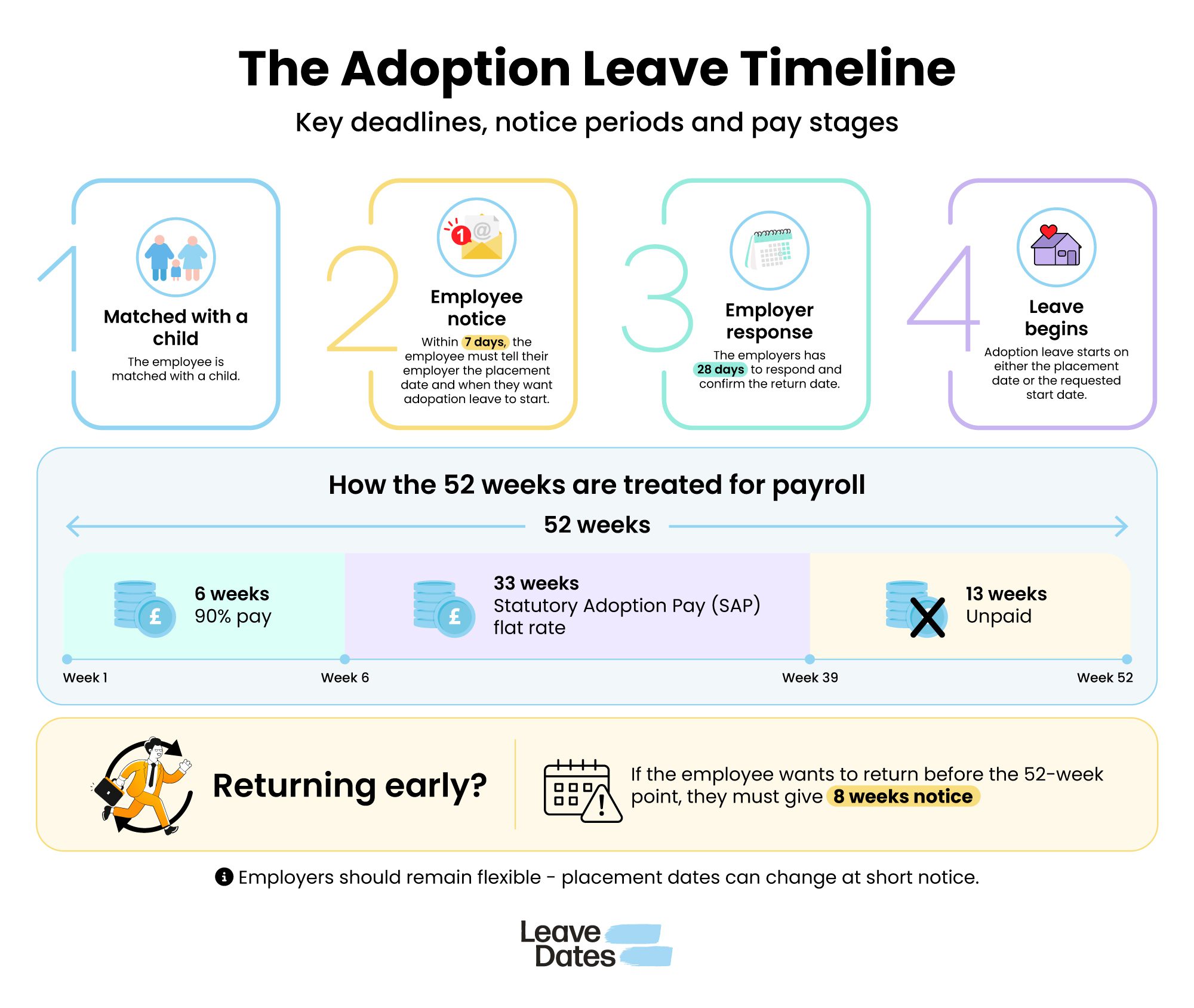
While you might have a bit more advanced warning of an adoption date than waiting for waters to break, there is still scope for unpredictability and short-notice changes, so employers should be flexible. Even so, the process will always follow the same order and rough timeline, which can guide your HR process and keep you compliant with relevant deadlines:
- The employee is matched with a child. They have 7 days to notify their employer of the placement date and the date they want their adoption leave to start.
- The employer then has 28 days to respond and confirm the return date.
- The leave begins on either the placement date or the date requested. Payroll treats the next 52 weeks as follows:
- 6 weeks 90% pay
- 33 weeks SAP flat rate
- 13 weeks unpaid
If the employee wishes to return earlier than the 52-week point, they must give 8 weeks notice.
Parental leave for adoption
While adoption leave fairly closely tracks maternity leave, you might be thinking, what about shared parental leave? Good news - this added flexibility, a big win following the Children and Families Act of 2014, is also available for adoptive parents. Even so, it is a major gap in many adoption leave policies.
Like those on maternity leave, an employee on adoption leave can choose to end their leave early in order to share it with their partner. The shared parental leave then functions in exactly the same way – two parents can take it simultaneously to be off at the same time, or consecutively, so that one returns to work and the role of ‘full-time parent’ swaps over.
Adoptive parents may (though not necessarily) be more likely to have a non-traditional family setup in terms of gender roles, which could make SPL a more useful option. But when deciding whether to take standard adoption leave or SPL, there are a few key considerations:
Build a family-friendly workplace
Leave Dates manages all types of family-related leave with ease, helping you build a supportive culture that works for everyone.
How employers can manage adoption leave
So this all sounds great and pretty simple in theory, but in reality, there’s paperwork. And the best way to deal with paperwork is… to go paperless. (Seriously.)
Managing long-term absences, especially ones with non-concrete start dates, potential early returns and maybe a stop-start thing going on (you could even have a couple working for you, taking shared parental leave for the same adopted child). A wall calendar isn’t going to cut it. A spreadsheet won’t either. You need a strategy and software to help you execute it. To fit adoption leave seamlessly into your leave policy and management process, your priorities should be to:
Avoid schedule conflicts
When an employee is on adoption leave, your team’s capacity is reduced. You may not be able to cope with other key team members taking extended holidays simultaneously. Using a tool like Leave Dates gives you a visual wall chart of your team’s availability across the whole company. You can see the full 52-week adoption block at a glance, helping you make informed decisions when other leave requests come in, or even block out certain weeks in advance so there are no nasty surprises.
Track entitlements and KIT days
Like maternity leave, employees on adoption leave can work up to 10 ‘keeping in touch’ (KIT) days without ending their leave. These are great for keeping communication active and ensuring a smooth return to work, but tracking them manually (tempting for this kind of ad hoc stuff) can lead to payroll errors.
Leave Dates can log KIT days and track how many weeks of leave remain, allowing HR managers to focus on the comms side of things. This is what’s most important in keeping those on parental leave in the loop and still feeling like part of the team.
Deal with holiday carry-over
Employees continue to accrue their normal annual leave while on adoption leave. It’s common to want to tack this holiday onto the end of their leave, effectively extending their time off. You need to account for this in budget and capacity planning.
Manage multi-location teams
When managing hybrid workforces or teams spread across different regional offices, keeping everyone aligned on resource gaps can be hard. If a localised manager sorts out cover in a silo, it can easily lead to understaffing across the wider company. A centralised, cloud-based leave tracker ensures that leadership, HR and line managers across all locations see the same, accurate and live, source of truth re: who is off and when.
Avoiding common adoption leave mistakes
While it is a different form of leave as far as payroll and admin are concerned, its purpose and value are identical to maternity. If you offer enhanced maternity leave/pay, you should mirror this in your adoption leave policy to avoid a discrimination claim.
Legally, you are entitled to ask for the Matching Certificate, but no more than that. The details about the child and the adoption are private.
With extended leave, you risk losing an employee if you lose touch with them. Agree in advance on what kind of updates they’d like to receive while off.
Centralised, live-updated tracking that is universally accessible is essential for planning.
Summary
Adoption leave doesn’t have to be a disruption. By creating a clear policy, understanding SAP, and using a centralised, visual management tool like Leave Dates to track absence, you can support all your employees’ growing families while keeping your business running smoothly.
FAQs
Adoption leave is a statutory right that allows an employee who is adopting a child to take up to 52 weeks of protected time off work to bond with their new family member.
Statutory Adoption Leave is a total of 52 weeks, split equally into 26 weeks of Ordinary Adoption Leave and 26 weeks of Additional Adoption Leave.
Any worker with legal ‘employee’ status who has been newly matched with a child by a registered UK adoption agency qualifies for adoption leave from their first day in the job.
No, only one designated primary parent can take Statutory Adoption Leave; the other partner may be entitled to take Paternity Leave or Shared Parental Leave instead.
Statutory Adoption Pay lasts for 39 weeks, paying 90% of the employee's average weekly earnings for the first 6 weeks, followed by a flat rate of £194.32 per week (or 90% of their earnings, whichever is lower) for the remaining 33 weeks. The rest of the leave is unpaid.
Parental leave for adoption usually refers to Shared Parental Leave (SPL), which allows adoptive parents to convert 50 weeks of the primary adoption leave (and 37 weeks of SAP) into a flexible pot that both parents can share or take in alternating blocks.


