
In this article
Quick takeaways
Successful employee retention comes from a balance of competitive compensation with supportive workplace culture, career growth, flexible conditions and great communication
Replacing an employee is expensive, so tracking turnover metrics is essential for protecting your bottom line.
- Today’s UK employees may switch jobs for higher pay, but they stick around for autonomy, flexible working and a sense of shared purpose
In any business, a loyal, experienced and high-performing team working towards a shared goal is a huge asset. But in a busy labour market like the UK, building (and keeping hold of) this kind of team takes more than just competitive pay. Employee retention strategies aimed at reducing employee turnover are just as, if not more, important than recruitment strategies. Because it doesn’t matter how many people you’ve got knocking on the front door if you’ve got a steady (and expensive) talent drain going out the back.
Being an attractive employer means creating a culture where the best talent chooses to stay and grow. For business owners and HR professionals, that means mastering employee retention strategies to prevent departures, compound company expertise and gain a competitive edge.
What are employee retention strategies?
Employee retention is the opposite of employee turnover. Simply put, it means staff are sticking around and staying with an employer for the long term rather than having their heads turned by something shiny. (Ice cream vending machines? Oooooohh.)
In the UK, skill and talent are in high demand, and knowing how to raise retention rates is key to sustainable growth. Skilled employees are business assets that, once you have them, you want to keep and nurture. A strong employee retention strategy is a proactive plan to create a culture and work environment where employees feel valued, challenged and supported.
High employee retention (by reducing turnover) reflects the long-term success and value of your culture and shows that your retention plan is working and that you’re meeting the modern worker’s needs.
Why employee retention matters for UK businesses
Having committed and engaged employees (who are the kind who stick around) pays dividends across every department and gives you a competitive edge. Companies that nail this benefit from:
High productivity
Experienced employees are more efficient and can mentor others, raising the entire team’s output. They also have ‘institutional memory’ that helps with project momentum and keeps operations running smoothly.
Stronger client relationships
The UK has many service-based industries, where trust is key. Long-term staff build deeper, trust-based relationships with clients that carry immense value and can’t simply be handed over to someone else.
Good employer reputation
A company known for its long-tenured staff often becomes a ‘talent magnet’, making future recruitment easier and more cost-effective.
Cultural strength
A stable team enjoys higher levels of trust, more collaboration and support, and creates a welcoming environment for new hires.
Cost-efficiency
Recruitment is expensive. Retaining talent means you can reinvest recruitment budgets elsewhere, like innovation and employee benefit schemes.
Top employee retention strategies that actually work
To build a world-class team for the long-term, you want to focus on the ‘5Cs of retention’: compensation, culture, career, conditions and communication. Let’s look at what that means in practice.
A great employee retention strategy begins well before the first day, with onboarding. By going out of your way to make a new hire feel like an immediate vital part of the team, you set them up for years of mutual loyalty.
- The first 3 months: Use a structured onboarding programme that focuses on social integration, with clear milestones and opportunities for morale-boosting ‘quick wins’ for the new team member to hit the ground running.
- Ongoing: Setting aside budget for L&D (Learning and Development) shows employees that you are invested in their long-term career. This is about more than money, though; you need to provide a vision of the future with an individualised progression plan and regular check-ins to see how they’re feeling, what they’re doing and what they want to do next.
“Loyalty costs nothing” – erm, not true. Employees need to feel appreciated before they can feel loyal; this is a two-way thing.
This is not (just) about money. The employee retention examples that work best in the UK often involve more than just pound signs; a fair salary is a given, and competitive pay will always be a draw. You can encourage and reward loyalty with things like:
- Personalised recognition: Celebrate milestones, project completions and ‘above and beyond’ moments. Recognise them as a person, not a resource, by recognising life achievements beyond work – a first home purchase, wedding, or the birth of a child.
- Value-based rewards: Offer benefits that actually matter to and benefit your team, such as “wellbeing hours”, sabbaticals, or extra holiday for long service.
Loyalty comes at a cost, but disloyalty costs more – businesses can have to shell out double an employee’s annual salary to replace them.
Much like romantic partners, for people to stay with you long-term, they need to be able to see a future with you and to like what they see. How do you convince them you’re “the one”?
- Engaging experiences: Make it clear that there will be opportunities for new skills, knowledge and challenges, to avoid people getting “itchy feet”.
- A clear path: Use regular check-ins to discuss career goals, ensuring every team member has a “next step” that they are working towards and motivated by.
- Promote from within: Prioritising internal candidates for leadership roles proves to your team that hard work pays off and that you are as invested in a shared future as they are.
Most importantly, you need to put your money where your mouth is. It’s all well and good to talk a good game, but you must actually invest in employees’ career growth for them to be convinced of your commitment.
This one is simple. There are loads of great places to work these days. If your workplace doesn’t offer a good environment, physically or culturally, people won’t stay long. To make sure it is, you need to give people what they want, which these days tends to mean flexible work and a focus on wellbeing.
- Autonomy: The old adage, “If you love them, set them free” holds true here. If you respect your employees and want them to be loyal, give them freedom and control over their schedule. This shows and builds trust like nothing else.
- Health policy: Beyond just a sickness absence policy, having proactive, holistic support in place, such as Employee Assistance Programmes and mental health provisions, shows that you want your team to be “well”, rather than just “not sick”.
In the UK, workers are increasingly prioritising ‘purpose’ at work. They want to feel like valued partners, not cogs in a corporate machine, so culture is often the deciding factor in whether a person stays for one year or ten. A transparent, inclusive culture is the backbone of any retention plan. On the ground, this looks like:
- Open communication
- Accessible leadership
- Employees feel invested in the company’s success
This doesn’t come about by accident, and takes dedicated and ongoing effort, and consistent daily actions that reinforce the “company values” on the wall.
How to measure and calculate employee retention
How do I calculate employee turnover?
Measuring employee retention gives you a clear marker of success and shows when your strategies are working. To do this, it’s actually easiest to work out your turnover rate. “OK, so how do I calculate employee turnover?” you might be thinking.
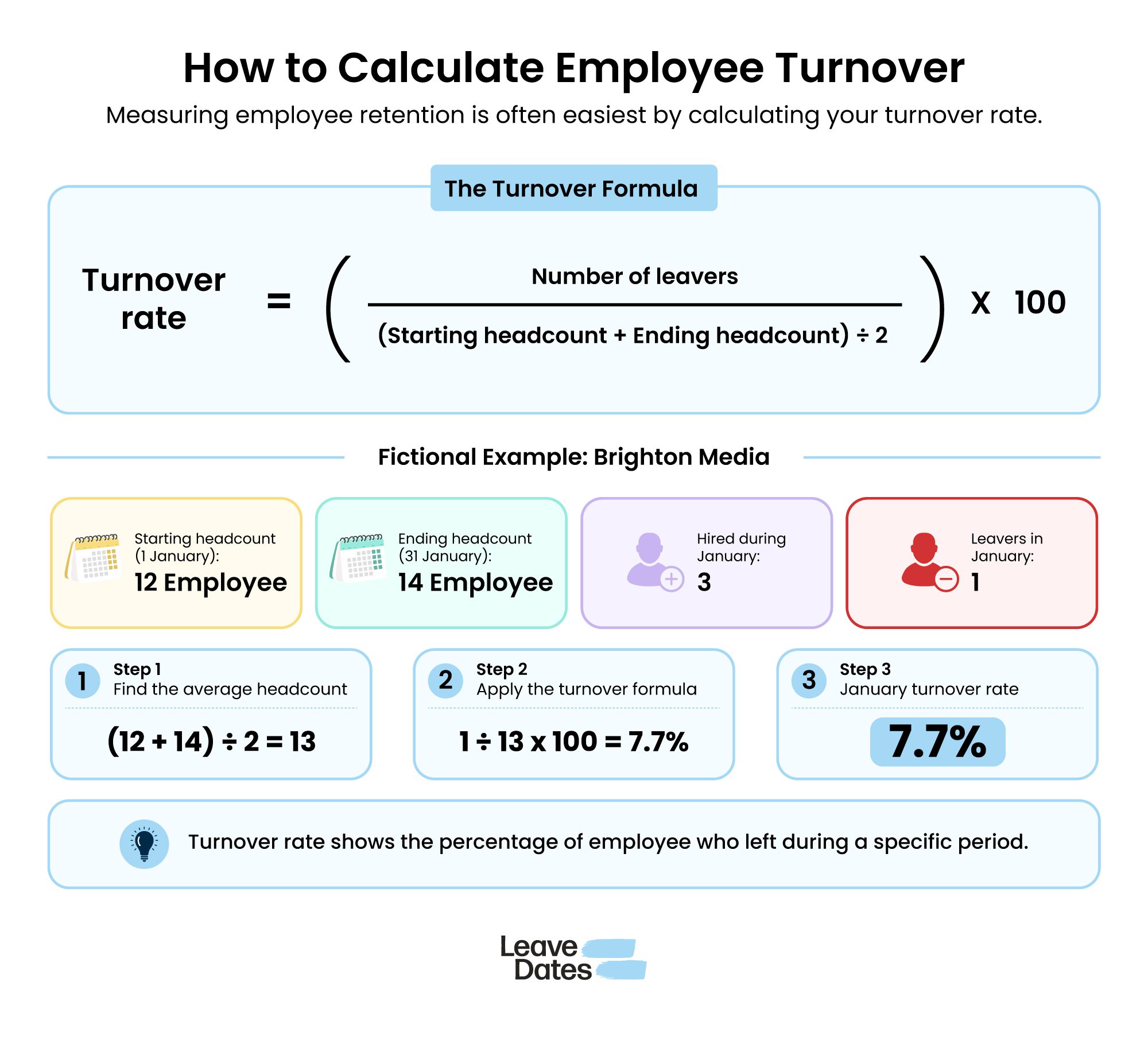
The Turnover Formula
To find your employee turnover rate, take the number of people who left during a period and divide it by your average headcount, then multiply by 100. Let’s see a fictional example:
Brighton Media
- Starting headcount (January 1st): 12 employees
- Ending headcount (January 31st): 14 employees (hired 3 new people, 1 person left)
- Leavers in January: 1
Before we can run the turnover formula for January, we need the average headcount for the period: starting count (12) plus ending count (14), divided by 2 = 13.
Now, we take the number of leavers (1) and divide it by the average headcount (13) = 7.7
Interpreting the result
In this example, Brighton Media has a monthly turnover rate of 7.7%. If that happened every month, the annual turnover would be over 90% – a major issue. But if no one else left all year, it would stay around 8%. In the UK, anything under 15% ish per year is pretty great and a sign that your employee retention strategy is working.
By tracking this metric monthly, you can keep on top of this and adapt quickly where you see red flags or successes you want to expand across the business.
For a small business, tracking turnover is extra important as each leaver has a much bigger impact on the business. Then it’s not just about retention success but the overall stability of your workforce. In the example above, in a team of 13, one leaver represents 7.7% of the workforce; in a business with 1,000 employees, they’d be just 0.01%
Successful retention strategy examples in the UK
The ‘shared success’ model: Companies like the John Lewis Partnership give employees a stake in the business, ensuring everyone benefits from the company’s growth.
Sabbatical rewards: Many UK firms, such as Monzo, offer paid sabbaticals to reward long service, allowing staff to return refreshed and recommitted.
- The four-day week: An increasingly popular model in the UK that focuses on output rather than hours, offers greater autonomy, which increases loyalty. UK firms like Atom Bank have seen retention skyrocket while maintaining high productivity levels.
Implement creative custom leave policies
From birthday leave to duvet days and sabbaticals, modern businesses are using leave as an incentive to recruit and retain talent.
Leave Dates helps you implement any leave policy in a few clicks.
Start your 30-day free trial today!
Common mistakes and how to avoid them
The world of work is always changing, and what worked yesterday may not be so motivating today. Younger workers are increasingly losing interest in pension schemes, for example, which were a huge draw for the Boomer generation. Today, there are some common pitfalls to avoid when trying to hold onto your talent:
Over-relying on salary
Yes, competitive salaries are essential, but that’s what job-hopping is for. People move for money, they stay for culture and purpose.
Ignoring employee feedback
Your employees know what they want, ask them – and listen.
Not learning from leavers
Find out why they’re leaving – are they running to, or from something? What’s drawn their eye, or driven them out?
Key takeaways
In the UK, where skilled talent is in high demand, understanding how to raise retention rates is the key to sustainable growth. High retention is the ultimate indicator that your retention plan is meeting the modern worker's needs for purpose and balance. By investing in the people you have today, you are building the foundation for your next decade of success.
FAQs
The 5Cs of retention are compensation, culture, career, conditions and communication.
You can raise retention rates by combining fair pay with regular career check-ins, flexible working conditions, transparent culture and structured onboarding.
Divide the number of employees who left during a period by your average headcount for the same period, then multiply by 100 to get your percentage.
Successful strategies include offering paid sabbaticals for long service, implementing a flexible four-day workweek, providing internal promotion paths, and utilising employee assistance wellbeing programmes.
High retention helps performance by driving productivity through institutional memory, lower recruitment costs and stronger, trust-based client relationships.


