In this article
Quick takeaways
- Honesty is the best policy – legitimate sick leave reasons are wide-ranging, communicate clearly and early in line with company policy
- Presenteeism is costlier than absence – working when unwell is a false economy; it drastically reduces productivity, prolongs recovery time, risks infecting colleagues and leads to burnout
- UK law on sick leave – you can self-certify for 7 calendar days, then you need a ‘fit note’.
When you wake up feeling like you’ve swallowed a hedgehog, or you’re teetering on the edge of burnout, and your mind is screaming ‘no more’, the question of whether to call in sick rears its ugly head.
For some, it’s an easy decision – you’re sick, you can’t work, it’s as simple as that. For others, it can be fraught with unnecessary anxiety or guilt. ‘What will the boss say?’ ‘I can’t let my team down!’ ‘There’s too much to do, I’ll just push through.’
Stop right there.
Sickness absence is a standard, unavoidable part of life, and something that UK employers should be well prepared for. Yet there can be a culture of ‘presenteeism’ – working when unwell – which puts employees under pressure, whether overt or subtle, to ‘power through’.
This guide is for everyone – employees, managers/owners and HR teams – looking for a clear idea of what counts as legitimate sick leave in the UK.
UK sick leave entitlements
Eligible employees are entitled to statutory sick pay (SSP), currently £123.25 per week or 80% of average weekly earnings, whichever is lower, paid for up to 28 weeks. Since 6 April 2026, SSP is payable from the first day of sickness, and the minimum earnings threshold has been removed so employees can qualify regardless of how much they earn — provided they meet the other eligibility requirements. Some employers pay more than this if they have a sick pay scheme.
What counts as a legitimate reason to call in sick?
So you’re legally entitled to sick leave and pay, but what’s a valid reason to use it? In short, if your physical or mental state genuinely prevents you from carrying out your contracted duties to a fair standard, or if you pose a risk to others, you can call in sick.
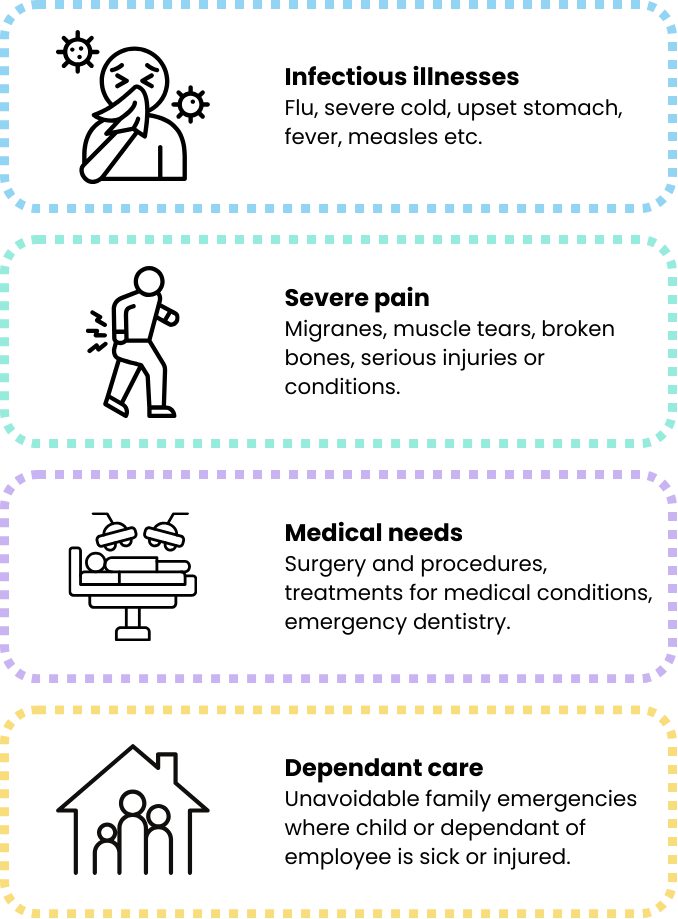
Common reasons for taking sick leave in detail:
Flu and severe colds
Maybe not the sniffles, but the full-blown, body-aching, fever-ridden misery. If you have a high temperature, you are almost certainly too ill to work and likely very contagious. Stay away.
Upset stomach
Whether due to a virus or food poisoning, if you’re spending longer in the bathroom than at your desk, you’re of no use. It’s incapacitating and a contagion risk. You don’t want this person anywhere near the office.
Migraines/severe headaches
These are particularly tricky for people in roles that involve a lot of screen time, as they often come with light sensitivity as well as nausea and intense pain. You’ve got to ride these out at home, preferably in a dark, quiet room.
Infections requiring antibiotics
For example, chest infection, ear infection, anything with a fever. If a doctor has told you to rest, don’t go to work.
Severe anxiety or panic attacks
If you can’t function or communicate effectively, you can’t be at work.
Burnout and stress
If you’ve pushed yourself past the point of return and stress is resulting in fatigue, extreme upset and inability to focus, you’re not going to recover until you step away for a while. A few days off can prevent a full-on breakdown or need for long-term medication.
Depression
While long-term depression is a condition that needs to be managed, a day where the symptoms are overwhelming and mood is especially low is a reason to call in if you can’t mentally engage with your responsibilities.
Injury/procedure recovery
If you’re recovering from an injury or surgery, it’s entirely reasonable to take sick leave while you heal. Whether the procedure was planned or an emergency, returning to work too soon can slow recovery or lead to complications.
Dental or medical emergency
Sudden or unexpected dental or medical issues are a legitimate reason to call in sick, but routine appointments are not. If you’re experiencing severe pain, infection, broken teeth, or an abscess, you can request a sick day to manage it.
Emergency care for dependants
Though it’s not technically the employee who is sick, UK law allows for the right to reasonable (unpaid) time off in the case of unavoidable absence. For example, if a child is ill and can’t go to school, or there’s an unforeseen issue with a parent or spouse (a fall, they’re ill, etc).
Take note that while a manager may ask about symptoms – eg to assess your fitness for work – you don’t need to go into detail. If there’s something you’re not comfortable telling them, you don’t have to. You also do not need to mask mental health issues with a fake stomach bug. It is up to managers to ensure there is no stigma around this, as ACAS guidelines say that mental health is treated equally to physical health.
And, for the sake of balance, here are some reasons that aren’t quite good enough:
- A hangover
- Just don’t fancy it
- Something good is on telly
- It’s sunny/snowing
The cost of presenteeism
So we know you can take time off when you’re sick, but what if you don’t want to? Or feel like you can’t/shouldn’t? Let’s address the elephant in the Zoom meeting: you should never work sick.
Presenteeism vs sickness absence: the real numbers
There’s no badge of honour for toughing it out. Trying to keep going when you’re unwell – whether physically or mentally – does far more harm than good, both to the individual and to the business. Sick leave costs the UK economy around £100bn per year, which is a little sickening itself.
But presenteeism also comes with a staggering cost. Deloitte estimated it at £24bn annually, but a 2024 report by the Institute for Public Policy Research gave a much higher figure, £103bn. They cited the ‘vicious cycle’ of knock-on effects on productivity, meaning several workdays are affected, with their analysis finding that 43.6 productive days per employee per year are lost to presenteeism.
By those accounts, presenteeism is just as expensive for businesses as sickness. And how much of that sickness has been caused by presenteeism in the first place? One thing is clear – no one saves by showing up sick.
Hidden costs or working while unwell
But it’s not just about weighing up the cost of presenteeism against the cost of sick leave. Rest is a necessity, not a luxury. Without it, we can’t function, and when you’re unwell, it’s essential for recovery. If you push through illness, it will likely backfire, you recover more slowly, perform below your best, and may ultimately need more time off.
For the business, too, it’s of no benefit. It’s a false economy – while the worker might physically be at work, there’s no way that they will be performing to the level they do when they are fit and well. They’ll make mistakes, work slower and quality/service will suffer. This means a massive productivity drop.
You also risk multiplying the problem. If they’re ill with a virus (and let’s face it, there’s a few of those about!), do you really want them in the office, coughing their germs into the air con? What you gain from that day of work you’ll lose five times over the next week when the whole team comes down with it.
A vicious cycle then becomes a full-on doom spiral as the hit to overall team productivity compounds. As an employer, you have a duty to look after your staff; if you know someone is not well, you should actively encourage them to go home and rest, for their own and everyone else’s benefit.
How to report sickness properly
No matter the reason for calling in sick, the process should be the same for everyone. For it to run smoothly, each side has some obligations:
What employees need to do
- Notify ASAP via the most direct platform (eg via the Leave Dates app), ideally before your start time, via the method outlined in your policy
- Give the reason and expected return date
- If absence goes over 7 days, you’ll need a ‘fit note’ from a registered health care professional.
Sick days simplified
Track sick days, entitlements and leave balances with complete accuracy using Leave Dates. Keep your records thorough and your team supported.
What employers are responsible for
- Have a clear, written policy setting out reporting procedures, sick pay and the return to work process
- Apply this consistently and fairly, treating mental health absence with the same sensitivity and importance as physical
- Return to work interviews – a short, private chat upon return is best practice and ensures they are genuinely fit to be back and have what they need
Reporting sickness in modern workplaces
Thanks to the joys of modern technology, you don’t have to literally phone in sick anymore. With so many communication tools available now, it seems a little harsh to have to pick up the phone and speak to someone when you can utilite the technology at your disposal.
A good online leave management tool like Leave Dates can make a big difference to the speed and efficiency of reporting absence and take the headache out of reporting your migraine (wahey). No need to worry that you don’t sound ‘ill enough’ or ham it up with a strategic cough or sob; you can report via the app.
Final thoughts on creating a healthy sick leave culture
Sickness is a part of life. If getting out of bed feels like a Herculean task, you shouldn’t think twice about phoning in sick. Employers should understand that creating a culture where employees feel they can’t phone in sick is a direct path to higher long-term business costs.
A fair, clear sick leave policy and an attitude that encourages staff to take sick leave when needed is an investment in sustainable productivity.
Presenteeism is worse than a false economy; it’s a real drain on valuable resources. A person struggling through flu or dealing with debilitating anxiety needs rest, not stress. They will be operating at a fraction of their capacity, so there’d be zero point having them in the office anyway.
So if you need a day off – take one. Your mind/body, your colleagues and even your employer will thank you for it.
FAQs
Do I have to call my manager or can I just text/email?
This depends on your work’s policy – you need to follow whatever reporting method is specified. Many UK companies prefer a phone call on the first day of absence as it ensures the manager has heard the news directly and can discuss immediate handover. You might then be able to text/email about subsequent days.
What if my sickness is due to work-related stress?
You can – and should – still call in sick. Work-related stress, anxiety or burnout is a legitimate medical reason for absence. A return-to-work interview is particularly important here to ensure this doesn’t become a cycle – your employer has a duty of care to ensure your job isn’t causing or exacerbating illness.
When do I need a sick note?
In the UK, you can self-certify for 7 calendar days (so including weekends and bank holidays) meaning all you need is your word – no medical evidence is required. Beyond this, you need a fit note from a healthcare professional (eg GP or nurse) to cover from the eighth day onwards.