In this article
Quick takeaways
- Holiday is earned pay, not a perk. Under UK law, accrued statutory leave is a monetary liability for the business.
- Automation avoids disputes. Manual calculations of pro rata holiday accrual are prone to error; digital tools provide accurate and auditable balances.
- Notice periods matter, and you may have a choice between requiring unused leave to be taken and payment in lieu of holiday (PILOH).
Your legal entitlement
The Working Time Regulations 1998 state that every worker in the UK is entitled to 5.6 weeks of paid annual leave each year (pro rata for part-time workers). This is the legal minimum, and a company may offer more. This paid leave accrues over time, and the employee’s right to it once it’s been accrued does not expire if they leave before using it. The law is 100% clear on this: any accrued but unused statutory leave must be given to the employee. There are no circumstances in which this leave can simply disappear.
But you can’t take a day off from a job you don’t have, so if time has run out, how do you benefit from paid leave?
How unused holiday pay works when leaving a job in the UK
How PILOH works
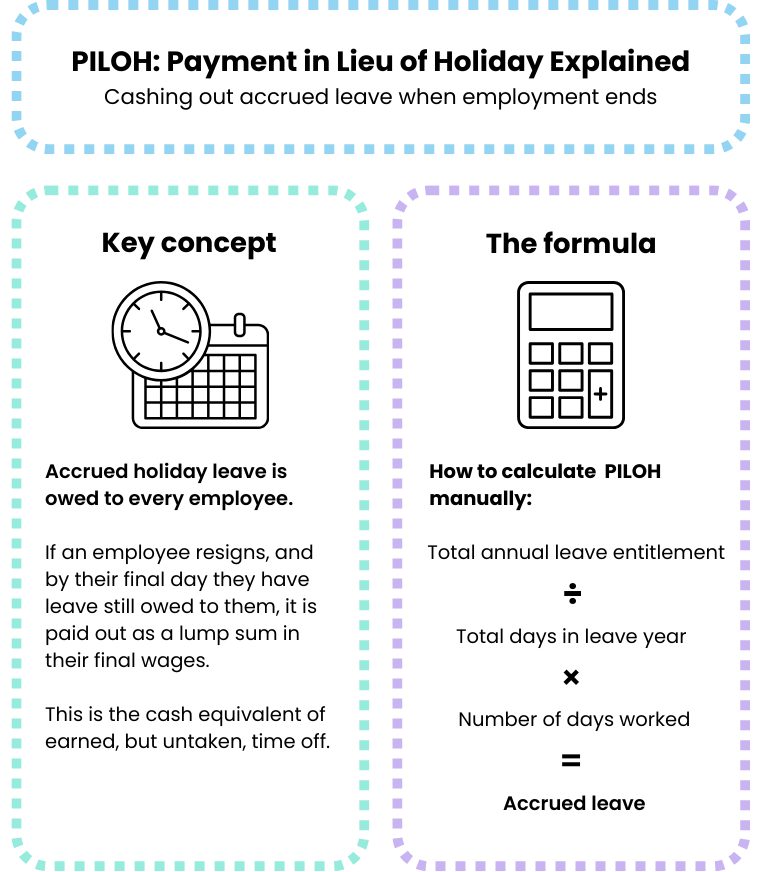
Accrued holiday is already banked – one way or another, it’s owed. If the clock – or calendar – runs out, the employee should receive ‘payment in lieu of holiday’ (PILOH), and it will be added to their final month’s pay. This payment is the cash equivalent of the time off they have earned but haven’t yet taken.
It’s calculated by working out how much of the company’s leave year (not necessarily the calendar year) the employee has worked/will work up to their last day. Then the formula is:
Total Annual Entitlement / Total Days in Leave Year x Number of Days Worked = Accrued Leave
For example:
Joe is a full-time employee entitled to the statutory 28 days’ leave per year (including bank holidays). The company’s leave year runs from January 1st to December 31st. Joe hands in his notice on June 15th and his final day is June 30th. Joe has worked exactly half of the leave year, so:
28 days (total entitlement) x 50% (portion of year worked) = 14 days accrued leave
Let’s assume Joe has already taken 10 days' leave, this means he has 4 days’ leave owed as PILOH to be added to his final paycheck.
The above example seems pretty simple, because it involves someone leaving exactly halfway through the year. But what if he left on May 13th? And is paid on commission? And worked overtime? This is where manual spreadsheets or, even worse, paper records, can get… messy.
Statutory obligations
For busy HR teams and business owners, trying to work out and track 5.6 weeks’ worth of accrual for multiple team members working different contracted hours and leaving at different times of year, all while juggling other HR admin, final pay runs and notice periods, is inefficient at best. This is where good leave software is worth its weight in gold, as it can automate all these calculations and track entitlements with precision, ensuring you stay compliant – and sane. Once you’ve received someone’s notice, it can give you their exact accrued leave balance up to a specified termination date
And on the subject of notice periods…
What about notice?
The default solution to unused holiday is PILOH, but there is another option in some cases. When someone quits a job, they’re required to work a notice period. This can be anywhere from a week to three months. Employers can encourage, or in some cases require, the employee to take some or all of their remaining annual leave during the notice period.
While it makes no difference to the bottom line – the worker will always get what they’re owed – this can be an attractive option for the business. For example:
Cash flow management
While the total cost to the company won’t change as the employee is paid either way, the timing and accounting of the expense can be strategic. It avoids a large final lump sum that can distort the final payroll and impact cash flow, a pain for a small business. If the employee uses leave, this spreads the cost across normal pay cycles.
Simpler admin
The employee's holiday balance is zeroed by their contract end date, so there is no ambiguity about final pay, and the business knows it’s 100% compliant. The payroll team also won’t have to calculate a one-off payment in lieu, which can be complex if you have to work out a weekly or hourly rate of pay for someone on irregular hours. (Of course, this isn’t an issue if you’re using leave management software!)
Risk mitigation
For senior staff or those in sensitive roles/areas of the business, there might be a strategic reason for encouraging or mandating leave to be taken at the end of employment. For example, businesses where IP protection and confidentiality are a concern. This is often referred to as ‘garden leave’.
Avoids disruption
Sadly, not all exits are happy ones. If an employee is not leaving on good terms, it can harm morale and staff cohesion if they linger. They could even be actively disruptive.
On the flip side, there are also a few reasons why you might want to avoid, or limit, an employee taking all their unused leave instead of working notice and instead prefer PILOH. Such as:
- Critical role/skills gap: For some roles, especially if they are unique or critical, the business might need them right up to their last day. For example, if one of your A-team has their head turned by an offer too good to refuse (unlimited leave, anyone?), it could be difficult and time-consuming to replace them. Or you might need them in order to remain operational, or to maintain a certain service level.
- Essential handover: A complex role might require the full notice period for thorough handover or finishing crucial projects. Losing a big chunk to take unused holiday could disrupt operations or delay critical work.
- Employee relations: It’s important to maintain good relationships with departing staff, both for your brand and for your remaining staff’s morale. Forcing leave if the person doesn’t want to take it can look and feel punitive and end things on a sour note.
There is a middle ground, where you can create a controlled exit, structuring the notice period into a time of active handover followed by mandated leave. This creates a window of time to ensure knowledge transfer and work handover, for a smooth transition.
Whether it’s more strategic to use up leave or pay in lieu will depend on the business and circumstances of the exit, but there are rules. If the employer is requiring the employee to use up leave, they are legally required to give notice that is at least twice the length of the leave period they are compelling the employee to take. That means, if you’re requiring someone to take 5 days’ leave, you need to give them at least 10 days’ notice.
Generally, giving people the choice, or using PILOH as a default is well-received and seen as a gesture of goodwill. It goes a long way toward keeping things friendly, and a good employer reputation will help with future recruitment efforts.
Sit back, relax, and let us calculate your leave.
Leave Dates automatically calculates all your staff leave — no spreadsheets, no manual maths, just accurate data at your fingertips.
When employees take more leave than accrued
While this article is about unused leave, the reverse situation can occur. If an employee is a savvy leave planner, thinking far ahead – often a parent, or someone using the ‘leave stacking’ method – it’s possible they could have taken more leave than they’ve accrued by the time they leave. This is known as an ‘overdrawn’ holiday. Technically, the employee then owes this paid leave to the business. You can work out the amount using the same formula as above, but in reverse – days accrued, minus days taken.
A word of warning, though – you can only deduct this from the final paycheck if the contract includes an explicit clause allowing for this. If not, it could be classed as an unlawful deduction of wages under the Employment Rights Act 1996, and you’ll have to write off the debt. A great reason to check your contract templates, and consult with a qualified legal professional.
Final thought
When employment ends, and there’s holiday left in the pot, it’s not going anywhere. All earned holiday belongs to the employee, in one form or another – this is protected by law. The only real variable is how and when this leave is used:
1. Enforced usage – where the employer requires the employee to take the unused leave during their notice period (if long enough).
2. PILOH – the employer pays the cash value in the final pay packet.
The most common approach is PILOH – this is more flexible, and often preferred by the employee. There are clear business benefits too. It’s a hard out and a clean exit. For employers, a checklist of best practices will keep your departures pain-free:
- Maintain accurate, up-to-date leave records using a system that shows real-time accrued balances at a glance
- Communicate clearly, early and in writing when giving notice
- Ensure contractual clarity on how unused leave will be processed
All of the above can be dramatically simplified by using the right tools. Leave Dates acts as your digital audit trail and removes the risk of human error.
All good things come to an end, whether amicable or otherwise, and departures is something every business will have to deal with. With the right systems, it doesn’t need to be stressful or a source of risk. Even better, mastering the final pay run will solidify your reputation as a fair, compliant and professional employer. You can have peace of mind that people will speak highly of your business even after they’ve walked out the door for the last time.
FAQs
No. You have a statutory entitlement to PILOH regardless of the circumstances of departure. If you quit, are made redundant or are dismissed, you don’t lose your holiday pay. The law protects all earned statutory compensation.
Maybe, but not automatically. Annual leave entitlement is distinct from your contractual notice period. You can ask your employer if you can take your remaining leave during your notice, meaning your last working day will come sooner, it is their decision and they have the right to require you to work your full notice period and pay you for unused leave via PILOH.
For PILOH, the pay rate should be based on what the employee would have received had they been working and taking holiday at that time. This is normal basic pay for fixed hours/pay; for those with variable pay, it’s based on the average pay for the last 52 working weeks.