
In this article
In the twenty-odd years I’ve been advising small businesses, holiday records have rarely been anyone’s priority. They matter when someone leaves and wants their accrued leave paid, or when a payslip is queried, and the rest of the time they sit in the background.
Until this year, there was no general legal duty to keep records proving you had given people their holiday. That didn’t mean records didn’t matter - workers could always bring claims about holiday entitlement and holiday pay, and if one arrived, your records were your defence.
Without them, you were left relying a little too much on memory and cobbling together information, which is not a comfortable position when someone is claiming money you may or may not owe.
But most small employers did what felt sensible, and managed pretty well. Leave was approved by a manager’s email, WhatsApp message, or a quick chat, and noted on a shared calendar or wall planner.
Someone in the office kept a spreadsheet, and payroll recorded what was paid (but not necessarily how many days had been taken or how the holiday pay was worked out). And when it came to tidying up, records were often cleared after a year or two, or when the person left.
None of that was negligent, it was a reasonable response to a law that left the detail to the employer. But the law has now changed, and “we’ve always done it this way” will no longer be enough.
Replace your sheets
Keep accurate holiday records without spreadsheets. Leave Dates logs every request, approval and balance automatically.
What has changed
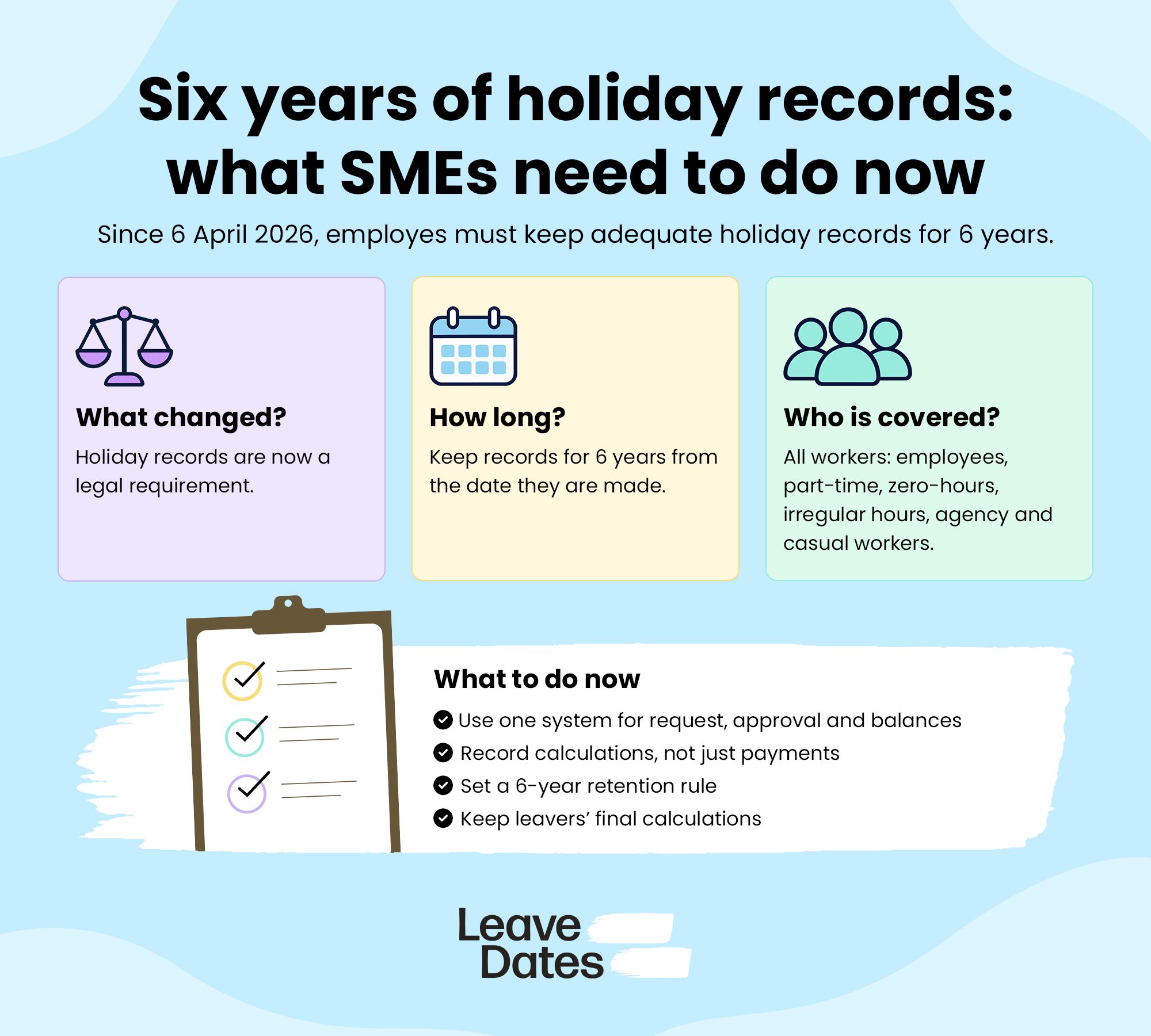
Since 6 April 2026, keeping holiday records is no longer simply good practice. Employers are under a statutory duty to keep “adequate” records showing that workers have received their statutory annual leave and been paid correctly for it.
Records must be kept for six years from the date they are made, and failing to keep them is a criminal offence, with potentially unlimited fines.
So the risk of a claim hasn’t changed, but two things have. Record-keeping is now a specific legal requirement in its own right, so you can be in breach even if no one ever complains about not having had the correct holiday. And the retention period has been set at six years, which is considerably longer than many small businesses were keeping anything.
Who does it cover?
The duty covers all workers, not just employees. Part-time, zero-hours, irregular-hours, agency and casual workers are all in scope, and actually those groups are in some ways most important.
People with the least regular working patterns are where most employers are more likely to slip up with calculating their more complex holiday entitlement or pay, so there’s more likely to be a claim. But they are often also the workers with the thinnest records, leaving employers in a difficult position when it comes to defending a claim.
What do records have to look like?
The law doesn’t tell you what system to use. You can keep records in whatever format you reasonably consider appropriate, provided they are genuinely “adequate”.
When it comes to what “adequate” means, the regulation doesn’t list every data point, so there is some judgement involved. But fundamentally, you need to consider this: if you were asked to prove you had given someone their full leave and paid them properly for it, could you do it from your records alone, without relying on anyone’s memory?
In practice, that means being able to show the worker’s entitlement for the leave year (including any pro-rating for part-year or part-time working), the dates of leave taken, any leave carried forward and why, how the holiday pay was calculated, and when and how much was paid. For anyone on rolled-up holiday pay, it also means showing that they qualify for it. For leavers, it means the final calculation and any payment in lieu.
The pay calculation is where there’s often a weakness. Many businesses can show what they paid but not necessarily how they got there. If someone’s holiday pay should reflect regular overtime or commission, you need to be able to show which elements you included and what reference period you used. If you can’t show your working, you can’t easily show compliance.
Keep your records clean
Every booking, carryover and TOIL balance is recorded and ready to export whenever you need it.
How far back do you need to go?
Fortunately, you don’t need to rebuild history. The requirement applies to records created from 6 April 2026, so the six-year clock starts there. Obviously that it doesn’t mean older records are worthless if a claim arises, so definitely keep whatever you do have. But don’t panic about trying to create what isn’t there.
What to do now
If you haven’t looked at this yet, you need to check what your position is and make sure you have a system for recording this information set up going forward. Here’s what I’d suggest as a starting point:
- Test your records on three people. Pick a full-time worker, a part-time worker and someone on irregular hours, and try to reconstruct each one’s holiday year from your records alone. If you find there are gaps, or information is difficult to find, you’ll know where to focus your attentions.
- Bring holiday data into one system. Records scattered across emails, calendars and separate files are your biggest risk. Decide where the definitive record lives, make sure leave requests, approvals and balances all feed into it, and check that it can produce a clear history for any individual on request.
- Record the calculation, not just the payment. Note which pay elements were included, the reference period, and the resulting rate, every time. Ideally this should link to payroll rather than being re-keyed.
- Check your rolled-up holiday pay arrangements. Rolled-up pay and the 12.07% accrual method are lawful only for irregular-hours and part-year workers. If you use them, record who qualifies and why.
- Set a six-year retention rule and check your systems obey it. Many HR and payroll platforms have default deletion periods shorter than this, and leavers’ records are often purged first. Align this with your GDPR retention schedule so the two don’t conflict.
- Make leave approval happen in one place. If managers are still approving holiday informally, your records will never be complete. The rule should be simple: if it isn’t in the system, it hasn’t been approved.
- Keep leavers’ final calculations with the rest of their record. That is exactly what you’ll be asked for if there is a later dispute.
Keep it proportionate
None of this means a business with a handful of staff needs an elaborate set-up. What matters is that your process is consistent, that approvals are dated, that your calculations are traceable, and that the records will still be there in six years’ time. Where employers struggle is when the process depends on one person’s diligence or one person’s memory.
The more your records rely on manual re-entry and individual goodwill, the more likely they are to have gaps, or for inaccuracies to slip in.
As businesses grow or take on more variable-hours staff, a joined-up HR or payroll system tends to become the sensible answer. It builds the audit trail as a by-product of everyday use, rather than something someone has to remember to do, and it makes the six-year retention far easier to manage. The cost is small compared with the exposure from a holiday pay claim that stretches back over several years.
Holiday records, sorted
Join 7,000+ UK businesses. Free for 30 days, no credit card needed.
The bottom line
The good news is that most SMEs are closer to compliance than they might think. They are usually doing the right things but not writing them down. A few weeks of tidying up, one clear process and a retention rule you actually follow will put most businesses in a strong position.
If you take one thing away, make it this: if it isn’t recorded, it didn’t happen. That was always true when it came to defending a claim, but it is now also a legal requirement.


